
Within the rationalist ambitions of eighteenth-century Enlightenment discourse, sensibility (Empfindsamkeit) emerged as a way of understanding how feeling and bodily experience were not beneath reason, but part of how human beings come to know, judge, and live with others.1 A key musical figure in this discourse was Carl Philipp Emanuel Bach (1714–88), the second surviving son of Johann Sebastian Bach (1685–1750). C. P. E. Bach’s music renders the inner life of Empfindsamkeit in strikingly audible form. For him, music was a mode of knowledge grounded in listening experience and cultivated feeling rather than merely in technical correctness or pure rational judgment.2 Prussia was one of the major centers of intellectual culture that understood music as “a natural [and social] human activity,” valued for its power to arouse feeling directly and thereby guide shared habits of sensibility in lived experience.3 The Enlightenment in Prussia took a more specific form through the thought of Moses Mendelssohn (1729–86), who considered culture a practical force that refines the habits, inclinations, and social customs through which people live together.4 Empfindsamkeit thus matters as a mode of shaping how we feel and respond to our sensation and sentiment.5 This framework provides the philosophical ground for hearing Bach’s music as a disciplined practice through which feeling becomes socially meaningful. By analyzing his third and fifth editions of Geistliche Oden und Lieder (1764, 1784), this article explores how the print circulation of Bach’s music helped cultivate sensibility as a socioethical capacity. In the process, I argue that C. P. E. Bach should be understood not only as a composer of the Enlightenment, but as a philosopher of sensibility.
Within eighteenth-century European thought, sensibility denoted a mode of knowing in which sensation, emotion, and thought were inseparable.6 What one perceived from the external world moved the body and soul at once; feeling was not opposed to knowledge but one of its first conditions. Historian Jessica Riskin highlights how Denis Diderot (1713–84) and his French contemporaries broadened the scope of empiricism. They expanded on John Locke’s account of the “sensory origins of ideas” into a model in which emotion and moral sentiment also contributed to how humans engaged with the world.7 Even science, for them, was influenced by this fusion of physical sensation and moral sentiments awakened by sensory experience.8 The significance of sensibility thus lies in how it unsettles the later understanding of the Enlightenment as “chilly, arid rationalism,” evincing instead a culture deeply invested in the affective and embodied basis of judgment.9 In the Prussian bourgeois context, this broader European discourse took the form of Empfindsamkeit (sensibility). Empfindsamkeit became a literary and moral ideal that sought to balance head and heart by cultivating sympathy, virtue, and an emotional life directed toward social relation and mutual care.10
A brief contextualization of Empfindsamkeit helps clarify the key qualities of civic cultivation that are central to my argument. Drawing on several strands of Enlightenment philosophy, Mendelssohn conceived of sensibility as a form of civic cultivation, one that refines sympathy, moral responsiveness, and social feeling into capacities for life with others.11 Civic cultivation, in this sense, names the formation of individuals capable of living well and responsibly within a shared social world. As a friend of C. P. E. Bach,12 Mendelssohn located this process within art itself, treating aesthetic experience as a space in which feeling, thought, and moral life are inseparably joined.13 Art therefore becomes a means of training feeling, whereby private experience may be transformed into mutual relation and social responsibility. Mendelssohn claims that rational thought arises from Empfindsamkeit: Immediate sensible awareness grounds both intellectual inference and natural knowledge, so even philosophy and science cannot proceed from pure concepts alone.14 Immanuel Kant (1724–1804), by contrast, gave greater weight to the free play of the cognitive faculties and to an aesthetic judgment whose determining ground “cannot be a concept.”15 Philosopher Paul Guyer notes that Kant tends to “deemphasize both sensations and sentiments” as unstable sources of agreement.16 Mendelssohn’s Empfindsamkeit is thus significant in that it keeps art tied to “desire and moral judgment as well as cognition,” whereas the Kantian ideal of taste narrows sensibility into a more formal and cognitively disciplined model of aesthetic experience.17
This broader intellectual world provides essential context for C. P. E. Bach, whose music gives Empfindsamkeit audible form by making feeling and embodied experience central to musical meaning. In 1740, Bach joined Frederick the Great’s royal court in Prussia as an accompanist.18 He moved not only within court music circles but also among Berlin’s lively literary and philosophical networks, especially the Monday Club of Berlin.19 There, Bach developed a friendship with Mendelssohn, whose sustained admiration for C. P. E. and the Bach family’s music helps explain why Empfindsamkeit took shape as both a philosophical idea and musical aesthetic.20 C. P. E. Bach’s famous insistence that one must play “from the soul, not like a trained bird,” rejects mere technical reproduction in favor of inward responsiveness, implying that music becomes meaningful only when it is grounded in lived feeling and attentive judgment.21 The frequent changes of texture, register, and rhythm that define his sentimental style ask both performer and listener to experience music as movement, surprise, and affective knowledge.22 As musicologist David Schulenberg observes, Bach’s compositions make “every note” count through their diversity of harmony, rhythm, meter, and pacing, demanding a refined kind of listening in which perception itself becomes a cultivated art.23
Schulenberg’s view is borne out by Bach’s Essay on the True Art of Playing Keyboard Instruments, where Bach treats performance as a disciplined practice of felt understanding.24 A musician, writes Bach, “cannot move others unless he too is moved.”25 He claims that musical knowledge begins in embodied experience: The performer must first register an affect inwardly, then clearly shape articulation, whereupon the listener can experience the performer’s affect.26 Affect here means a felt emotional state that music awakens through outward sound, bodily gesture, and within one’s private emotional experience.27 In this sense, the keyboard becomes a site of ethical and social formation, because it trains musicians not simply to display skill but to cultivate attentiveness to inner states and responsibility toward others’ perception.28 In the spirit of Empfindsamkeit, perception is the trained ability to respond to feeling as it unfolds in sound.29 Etienne Darbellay explains that Empfindsamkeit operates on “two levels of communication”: Whereas the sonata teaches affect through recognizable musical patterns, the improvisatory performance tests the player’s judgment in real time.30 Bach highlights how improvisation forces performers to turn immediate inner experience into intelligible musical expression that others can recognize, making private emotion communicable within a shared social world.31 Bach therefore shows that Empfindsamkeit must itself be cultivated.32 His philosophical significance lies in making music a medium through which knowledge becomes audible as relation—something learned by trained capacity to feel with precision.
By treating musical performance as a practice of cultivated feeling, Bach made a major contribution to mid-eighteenth-century pedagogical literature, exemplified in his Geistliche Oden und Lieder (Sacred Odes and Songs, 1758; abbreviated as Gellert Lieder). Gellert Lieder is a collection of devotional poems by Christian Fürchtegott Gellert (1715–69), a poet whose writing stands between the formal restraint of earlier classicist traditions and the more sentimental style of later “pre-Romantic poetry.”33 Gellert wrote his lieder to be sung in private worship with chorale melodies, marking the first time his poetry appeared in a form explicitly intended as “song texts.”34 Gellert Lieder’s popularity came in large part due to Bach’s “fully written-out keyboard accompaniments,” which already point toward the more “expressive keyboard writing” later associated with nineteenth-century German art song.35 In the preface to his first edition of the collection (1758), Bach explains that he composed the accompaniments in a way they could also function as solo keyboard pieces.36 His intervention was to refuse the older model in which poems could simply be set to chorale tunes or atop a lightly realized continuo.37 By fully writing out the keyboard part and presenting the songs as Handstücke,38 Bach turned the lied into both a devotional genre and a keyboard lesson: training players in expressive ornaments and phrasing techniques. In that sense, the improvisatory element moved into subtle decisions of touch and inflection that make feeling audible without distorting the text.39 Thus, Gellert Lieder presents Empfindsamkeit as disciplined responsiveness. The work deserves attention as a mid-eighteenth-century way of teaching performers how sound could communicate moral and emotional meaning.
Analyzing “Das Glück eines guten Gewissens” (“The Happiness of a Good Conscience”) from the Gellert Lieder shows how Bach teaches moral, spiritual, and emotional meaning through musical form itself (figure 1).40 The piece is set in A minor, marked “etwas langsam” (“somewhat slow”), and written in 3/4. The song begins with a measured, restrained pulse that makes the singer sound as though they are entering a devotional act in real time. Even before the lyrics introduce a “ruhiges Gewissen” (“quiet conscience”), the music establishes an atmosphere of calm, discipline, and spiritual composure. In the opening four measures, “Besiß ich nur / Ein ruhiges Gewissen” (“If only I possess a peaceful conscience”), the vocal line remains mostly syllabic and carefully paced, without ornamental expansion. Here, conscience is presented as something musically steady and inwardly controlled. This melodic restraint keeps attention on the clear shaping of each word, turning devotion into reflective thought rather than excessive emotion. The keyboard accompaniment supports this effect by providing firm harmonic grounding instead of dramatic agitation. Bach thus presents peace of conscience as a cultivated inner steadiness: a state of moral and spiritual balance capable of holding fear and uncertainty without giving way to them.
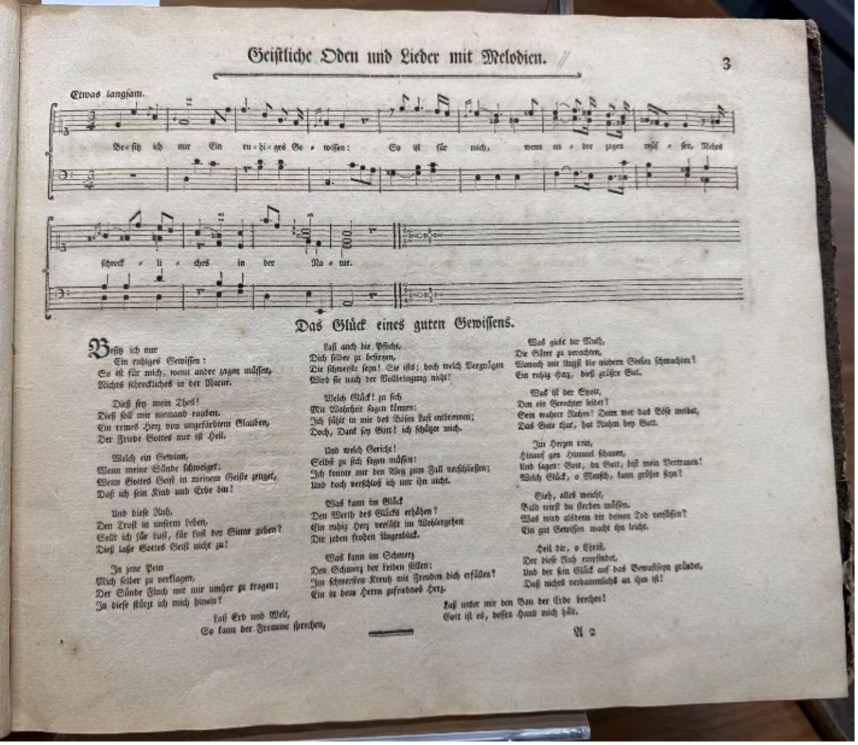
Figure 1 Carl Philipp Emanuel Bach and Christian Fürchtegott Gellert, “Das Glück eines guten Gewissens,” in Herrn Professor Gellerts Geistliche Oden und Lieder, mit Melodien, 3rd ed. (G. L. Winter, 1764) (hereafter Gellert Lieder [1764]). University of Toronto Music Library Rare Book Collection.
Bach’s setting becomes most revealing precisely when its opening calm is disturbed, because Empfindsamkeit values feeling as something morally clarified in sound.41 From measure 5 to the end—“wenn andre zagen müssen / Nichts schreckliches in der Natur” (“when others might despair, for me nature holds no terrors”)—the vocal writing grows more angular, and the harmony briefly darkens through more pronounced inflection and chromatic motion in the bass at measure 7.42 By moving from the subdued subdominant of iv6 to ii6, then tightening through the secondary leading tone of vii°7/V before arriving on V, the bass turns a broad minor-space descent into a compressed chromatic push toward E, so the harmony seems to gradually gather inward tension, which makes the moment of fear feel like an inner disturbance being drawn into focus and then held at the threshold of resolution.43 The approach to the cadence feels unsettled because the phrase leans toward instability before regaining balance, which makes conscience persuasive not as innocence untouched by trouble, but as inward peace that has passed through agitation and held itself together. This is where Bach’s music resonates with Mendelssohn’s account of Empfindsamkeit: Art is an “artful, sensuously perfect representation” that works through “shapes and sounds,” and it can “arouse our passions and tame them in turn.”44 This means that feeling is neither irrational excess nor mere decoration but part of how aesthetic experience forms judgment and response. The song therefore teaches a specific moral lesson: Fear belongs to human experience, but conscience becomes meaningful when emotion is disciplined into trust, steadiness, and relation to a larger order rather than left in panic or despair.
On the whole, Bach’s Gellert Lieder turns sensibility into a practice of civic cultivation by moving moral feeling out of the private inwardness of devotional poetry and into reproducible, shared use. In consideration of their increasing demand from less skilled players, Bach wrote the accompaniments in a way that is playable even by performers with modest keyboard ability.45 This meant that a poem could be learned in two ways at once; through singing and through playing, so that even amateur musicians could learn its affect and devotional import through repeated bodily practice at the keyboard.46 Bach’s achievement, then, was not simply to set Gellert’s texts beautifully, but to redesign access to them.47 The relationship between Gellert’s text and Bach’s music was shaped and reshaped through print, circulation, reprint, and reception. The poems became song texts through publication itself, entering the public not only as devotional verse to be read but as notated works to be sung and played. Reprinted in five editions between 1758 and 1784,48 the collection shows that the bond between Gellert’s words and Bach’s music was sustained through distribution and repeated use, not confined to a single moment of composition.49 Through publication and printed circulation, the Gellert Lieder cultivated singers and amateur keyboardists to internalize moral attentiveness and expressive judgment as habits of life with others.50 Bach’s settings therefore embody Empfindsamkeit at the civic level: They make inward sentiment portable across households and communicable across a reading public.
To understand how this civic work of sensibility extended beyond the act of composition, we must turn to the print culture surrounding the Gellert Lieder, where its successful dissemination reveals a politics of sensibility. From an early age in Leipzig, C. P. E. Bach learned that composing, engraving, printing, and selling music could all be merged into a single practice.51 Influenced by observing his father managing the publication of his own music, C. P. E. Bach tried the printing process himself in his youth. After 1750, he effectively carried that family print enterprise forward by continuing to circulate J. S. Bach’s oeuvre and upon inheriting the engraved plates of the Art of Fugue.52 This family tradition shaped Bach as a mediator of sensibility, giving music a tangible form that could carry sonic expression beyond the ephemeral moment of performance into a wider reading and music-making public. Empfindsamkeit here becomes political because print turns private feeling into something that can be disseminated and socially consumed, making emotion part of how the public learns what kinds of inner life should be valued. Accordingly, C. P. E. Bach’s compositions circulated through networks of aristocratic patronage and upper-middle-class circles, including those of Princess Anna Amalia of Prussia, Jewish banker Daniel Itzig, and Itzig’s daughter Sara Levy, who became one of the most devoted collectors of Bach’s music.53 Empfindsamkeit associated with his works thus acquired social authority as recognizable signs of cultivated moral perception.
The precise edition of the Gellert Lieder discussed so far is the third, published in 1764 by George Ludwig Winter in Berlin. Winter published the first edition in February 1758, with fifty-five songs in total; the collection’s strong reception led to four further editions in 1759, 1764, 1771, and 1784.54 In the third edition, Winter expanded the volume by adding twelve more sacred songs, also by Gellert and Bach, as an appendix to the original set.55 Printed elegantly on laid paper in an oblong quarto format and handsewn into brown cardboard, the seventy-five-page manuscript presents itself as a carefully produced devotional music book.56 The title page combines an elaborate rococo ornamental frame of foliage and small allegorical figures with crisp, densely inked typography, while the visibly toned paper lends the book a tactile sense of refinement (figure 2). Moreover, physical signs of handling suggest a score meant to be lived with in everyday musical practice. The rounded trimming of the inner pages—as exemplified by a copy held at the University of Toronto—was likely a later effort to neaten edges worn down by frequent page turning and thus preserves physical evidence of active use (figure 3). These marks show that the material cultures of print, domestic use, and institutional preservation helped produce sensibility through repeated practice, giving civic cultivation a tangible social function.
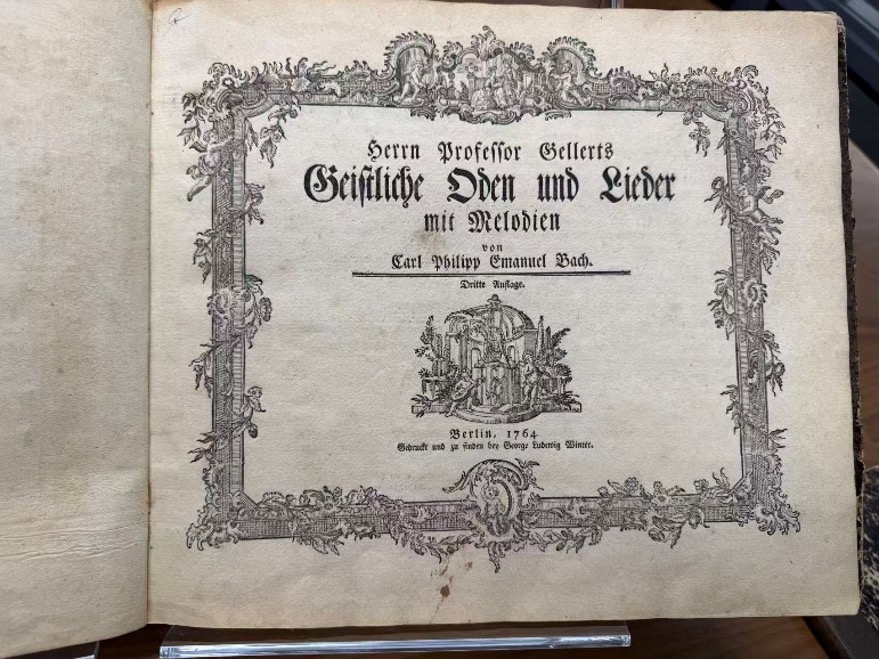
Figure 2 Title page of Gellert Lieder (1764)

Figure 3 Rounded trimmings
A close reading of Bach’s preface—identical across all five editions—clarifies the social significance of the songs’ printed circulation. In it, Bach presents Gellert’s poems as tools of civic cultivation through which music lovers may experience both aesthetic enjoyment and moral edification (figure 4). Bach explains that his songs are musical adaptations of Gellert’s publicly esteemed poetry, and that singing Gellert’s poems could become a way of learning the modes of moral feeling that civic culture sought to foster.57 Since Bach had been setting poems by writers he often knew personally in Berlin, he approached vocal composition with unusual care, treating musical setting as a socially answerable act in which expressive choices had to prove themselves before an educated public.58 Although Bach acknowledged the difficulty of setting music to “didactic odes,” the beauty and purposefulness of Gellert’s poems nonetheless inspired him “to put forth every possible effort” to extend their moral usefulness to a broader public through music.59 Around the time he first published the Gellert Lieder in Berlin, Bach had learned to write music whose expressive depth would become more accessible to a wider public.60 This sought-after appeal to a broader middle-class audience––as articulated by Bach himself in the preface––helped to sustain the collection’s popularity through multiple successful editions. At the same time, advances in print culture effectively carried the songs beyond elite circles into a wider culture of domestic cultivation.
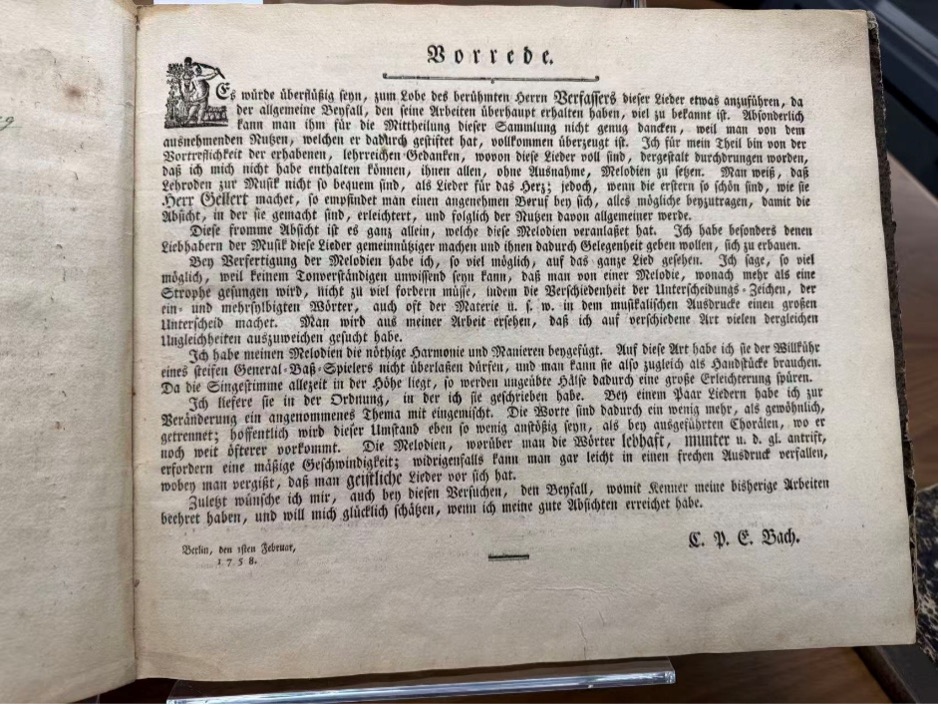
Figure 4 Preface of Gellert Lieder (1764)
Between the publication of the second and third editions, Friedrich Wilhelm Marpurg’s Kritische Briefe über die Tonkunst included a brief mention of Bach’s Gellert Lieder in a “Letter to J. F. Agricola”:
Because the Gellert muse’s themes are somewhat more sublime than wine and love, the distinguished composer could do nothing else than diverge from the usual procedures of ode style, and who could expect anything other than what is exceptional and always superb from the divine art of a Bach?61
The remark suggests that audiences and critics received the Gellert Lieder as something elevated above the familiar world of fashionable song. By contrasting Gellert’s “more sublime” themes with the conventional subjects of wine and love, the quote signals that the Gellert Lieder was heard as departing from the lighter anacreontic repertory associated with Berlin musical sociability. Bach’s settings were admired precisely because they matched the gravity of the texts: He was expected to leave behind ordinary ode style and produce music of unusual dignity and expressive depth. This tells us that the editions were valued as vehicles for the refinement of spiritual and inward feeling.62 Empfindsamkeit here becomes a carefully formed mode of feeling attuned to the poems’ sacred and moral seriousness. The favorable reception of Bach’s settings suggests that audiences recognized and valued this heightened expressive discipline as one of the collection’s central achievements.
Building on the success of the earlier editions, Bach issued a fifth edition of the Gellert Lieder with Johann Gottlob Immanuel Breitkopf in 1784, this time printed using Breitkopf’s newly developed movable type and thus marking its entry into a more automated era of score production.63 After the first several editions of the Gellert Lieder were issued by Winter in Berlin, Bach turned to Breitkopf of Leipzig for the final edition of the collection. Since Winter had passed away in 1772, and Bach had already left Berlin, there was little reason to keep using a Berlin printer by 1784.64 Other than the combination of the Gellert Lieder and twelve additional settings in the Gellert Anhang, the Breitkopf version remains virtually unchanged from the earlier editions, indicating that it was successful enough in its original form to warrant a straightforward reprint. As shown in figure 5, the fifth-edition title page has pencil marks at the top left corner and an unevenly trimmed upper margin, where the printed frame sits closer to the top edge than to the bottom, suggesting that the volume was cut and rebound after publication and remained in circulation beyond 1784.

Figure 5 Cover page of the 1784 edition. Carl Philipp Emanuel Bach and Christian Fürchtegott Gellert, Herrn Professor Gellerts Geistliche Oden und Lieder, mit Melodien, 5th ed. (Johann Gottlob Immanuel Breitkopf, 1784) (hereafter Gellert Lieder [1784]). University of Toronto Music Library Rare Book Collection.
Breitkopf’s new movable musical type refined earlier engraving methods by rendering notes and musical symbols with greater clarity and precision.65 This allowed for the reproduction of a composer’s manuscript with heightened mechanical accuracy. Yet the slight misalignments and small gaps between staff lines (as shown in figure 6) reveal the visible traces of this early stage of music-type printing. These gaps result from the use of modular music types assembled in short sections, which allowed for each measure to be set according to its specific notational needs. Bach strategically optimized this new printing system, whose lower cost and faster production enabled him to conceive works for even broader circulation than the earlier editions.66
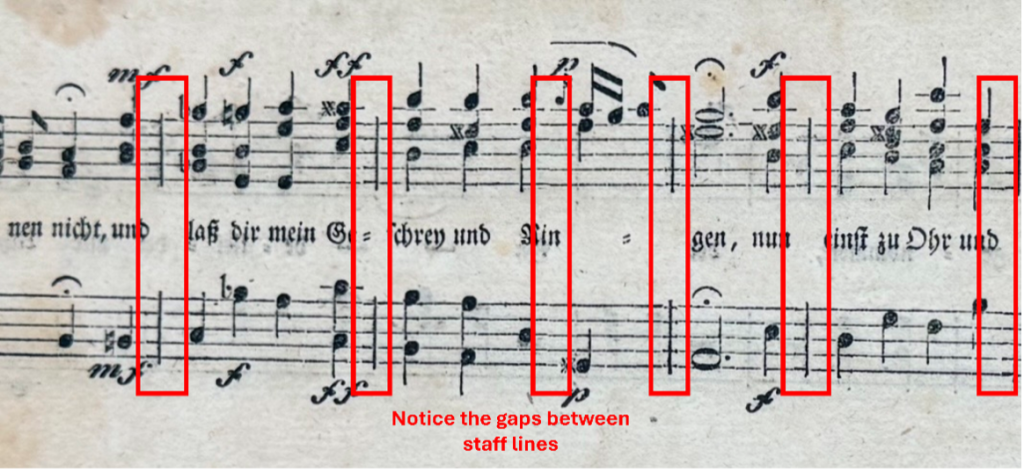
Figure 6 Gellert Lieder (1784), 74
Although improved printing technology undeniably expanded the reach of the Gellert Lieder beyond the narrow elite circuits of manuscript culture, its wider circulation remained bounded by social privilege. To benefit from such publication, one also needed the capacity to read scores and a keyboard on which the songs could be performed in domestic or devotional settings. In that sense, Bach’s publications did not exceed the social limits of sensibility, but they did extend its practices beyond courtly circles to a broader—though still socially restricted—public. If, as Maria Bania and Tilman Skowroneck argue, sensibility was understood “not as an innate quality but as a form of behavior to be learned,” then print became one of its central pedagogical vehicles: allowing feeling to be cultivated through the reading of scores and performance.67 However, the very medium that carried this promise had inherent limitations in delivering it. The printed score cultivated inward responsiveness only among those already positioned to acquire the habits of cultivated attention. Bach may therefore be understood as a philosopher of sensibility insofar as he helped formalize the pedagogical means through which feeling could be taught to a wider—though still socially limited—public. His publications attest to the early expansion of eighteenth-century civic cultivation rather than the complete democratization of it, since its uptake remained dependent on literacy and the domestic conditions that determined who could perform. What emerges here is the beginning of a broader culture of cultivated feeling, not its final, universally accessible form.
C. P. E. Bach invites us to understand eighteenth-century sensibility as an effort to restore a fraying sense of common life by cultivating forms of feeling as a basis for solidarity, a question that remains pressing in our present world increasingly affected by self-interest and isolation. Returning to Bach attunes us to how art can carry ideals beyond the historical circumstances of its creation and to remain available to later generations. Gellert Lieder was designed to travel through print, which allowed sacred language to settle into everyday practices of reading and singing. In that ongoing circulation, music became a way of preserving forms of address that encourage individuals to orient themselves toward broader moral and spiritual ideals. Looking back to this eighteenth-century project teaches us how history can preserve unfinished aspirations. Bach’s effort to cultivate sensibility opened the possibility of a public joined by shared habits of response and gave dissemination a formative role in shaping how people might engage with art in everyday life. In our present world marked by entrenched division and conflicts with those outside one’s own sphere, Bach’s music reminds us how art can carry forward ideals that a culture has not yet fully realized, keeping alive the hope that shared feeling may still be educated into a more generous and durable form of relation.
- Jessica Riskin, Science in the Age of Sensibility: The Sentimental Empiricists of the French Enlightenment (University of Chicago Press, 2002), 284.↗
- Reinier Munk, Moses Mendelssohn’s Metaphysics and Aesthetics (Springer, 2011), 294.↗
- Maria Bania and Tilman Skowroneck, “Affective Practices in Mid-18th-Century German Music-Making: Reflections on C. P. E. Bach’s Advice to Performers,” Early Music 48, no. 2 (2020): 200.↗
- William J. Mitchell, “Introduction,” in Carl Philipp Emmanuel Bach, Essay on the True Art of Playing Keyboard Instruments, ed. and trans. William J. Mitchell (W. W. Norton, 1949), 16–17.↗
- Bania and Skowroneck, “Affective Practices,” 197–98.↗
- Adam Smith, one of the major thinkers of sensibility, develops in The Theory of Moral Sentiments (1759) a view of human feeling centered on sympathy, the capacity to imaginatively enter into and share the passions of others. For the sake of analytical focus, this essay concentrates on Mendelssohn’s account of sensibility in order to give the discussion a more narrow philosophical frame.↗
- Riskin, Science, 2.↗
- Riskin, 284.↗
- Riskin, 283.↗
- Barbara Becker-Cantarino, “Introduction: German Literature in the Era of Enlightenment and Sensibility,” in German Literature in the Era of Enlightenment and Sensibility, ed. Barbara Becker-Cantarino (Boydell & Brewer, 2023), 14.↗
- Becker-Cantarino, 11.↗
- Steven P. Meyer, “Moses Mendelssohn and the Bach Tradition,” FIDELIO 8, no. 2 (1999): 49–50.↗
- Paul Guyer, Reason and Experience in Mendelssohn and Kant (Oxford University Press, 2020), 260.↗
- Munk, Moses Mendelssohn’s Metaphysics, 294.↗
- Guyer, Reason and Experience, 242.↗
- Guyer, 255.↗
- Guyer, 241.↗
- Mitchell, “Introduction,” 5.↗
- Gina Genova, “Carl Philipp Emanuel Bach’s Neue Lieder-Melodien nebst einer Kantate zum Singen beym Klavier (1789) and the Development of the German Lied” (master’s thesis, University of Arizona, 1995), 68.↗
- Guyer, Reason and Experience, 206.↗
- Quoted in David Schulenberg, The Music of Carl Philipp Emanuel Bach (University of Rochester Press, 2014), 7.↗
- Genova, “Neue Lieder-Melodien,” 93.↗
- Schulenberg, Carl Philipp Emanuel Bach, 141.↗
- Carl Philipp Emanuel Bach, Essay on the True Art of Playing Keyboard Instruments, ed. and trans. William J. Mitchell (W. W. Norton, 1949), 15–17.↗
- Bach, Essay, 152.↗
- Bach, Essay.↗
- Bania and Skowroneck, “Affective Practices,” 193–94.↗
- Bach, Essay, 152.↗
- Munk, Moses Mendelssohn’s Metaphysics, 198.↗
- Etienne Darbellay, “C. P. E. Bach’s Aesthetic as Reflected in His Notation,” in C. P. E. Bach Studies, ed. Stephen L. Clark (Clarendon Press, 1988), 58.↗
- Because this essay is concerned specifically with the Gellert Lieder and its printed, pedagogical, and affective dimensions, it does not pursue Bach’s improvisatory practice or fantasia style in detail. For a fuller discussion of those aspects of his thought and musicianship, see Tobias Plebuch, “Dark Fantasies and the Dawn of the Self: Gerstenberg’s Monologues for C. P. E. Bach’s C Minor Fantasia,” in C. P. E. Bach Studies, ed. Annette Richards (Cambridge University Press, 2006).↗
- Bania and Skowroneck, “Affective Practices,” 197.↗
- Genova, “Neue Lieder-Melodien,” 38.↗
- Genova, 57.↗
- Genova, 38.↗
- Genova, 56.↗
- Genova, 127.↗
- Handstücke literally means “pieces for the hand” and refers to standalone solo keyboard pieces.↗
- Victoria Polak, “Religious and Moral Concepts in the Eighteenth-Century German Novel of Sensibility: From Christian Fürchtegott Gellert’s ‘Leben der schwedischen Gräfin von G’ to the End of the 1770s” (PhD diss., University of St. Andrews, 1990), 210.↗
- Bach, Essay, 152.↗
- Guyer, Reason and Experience, 205–6.↗
- Schulenberg, Carl Philipp Emanuel Bach, 160.↗
- Schulenberg, 162.↗
- Guyer, Reason and Experience, 205.↗
- Genova, “Neue Lieder-Melodien,” 56.↗
- Genova, 57.↗
- Schulenberg, Carl Philipp Emanuel Bach, 162.↗
- Hans-Günter Ottenberg, “C. P. E. Bach and Carl Friedrich Zelter,” in C. P. E. Bach Studies, ed. Stephen L. Clark (Clarendon Press, 1988), 189.↗
- Genova, “Neue Lieder-Melodien,” 49.↗
- Guyer, Reason and Experience, 250.↗
- David Schulenberg, “Printing the Probestücke: An Eighteenth-Century Music Publication by C. P. E. Bach,” Harvard Library Bulletin 24, no. 3 (2014): 89.↗
- Schulenberg.↗
- Darbellay, “C. P. E. Bach’s Aesthetic.”↗
- Janet Winzenburger and Elinore Barber, “Riemenschneider Bach Library Vault Holdings,” Bach 3, no. 1 (1972): 33.↗
- Winzenburger and Barber.↗
- The lack of provenance makes it difficult to confirm whether the binding is original or was repaired later at certain point.↗
- Paul Corneilson, “Carl Philipp Emanuel Bach (1714–1788): The Intellectual and Musical Life and Legacy of an ‘Original-Genius’: Catalog of an Exhibition at Houghton Library,” Harvard Library Bulletin 24, no. 3 (2014): 15–16.↗
- Schulenberg, Carl Philipp Emanuel Bach, 140.↗
- Corneilson, “Carl Philipp Emanuel Bach,” 15–16.↗
- Schulenberg, Carl Philipp Emanuel Bach, 141.↗
- “Da die Gegenstände der gellertischen Muse etwas erhabner, als Wein und Liebe sind: so konnte der berühmte Componist auch nicht anders, als sich von der gemeinen Bahn der Odenschreibart entfernen, und wer könnte von göttlichen Kunsteines Bachs etwas anders, als was außerordentliches und allezeit vortrefliches erwarten?” Both the original German and translation quoted in Darrell M. Berg, “Introduction,” in Carl Philipp Emanuel Bach, Gellert Songs, ed. Darrell M. Berg (Packard Humanities Institute, 2009), xiii.↗
- Berg, xv.↗
- It later became the firm now known as Breitkopf & Härtel.↗
- Berg, “Introduction,” xi.↗
- Schulenberg, Carl Philipp Emanuel Bach, 124.↗
- Schulenberg, 124.↗
- Bania and Skowroneck, “Affective Practices,” 197.↗