
In Enlightenment contexts, music and its consumption were highly popular and achieved significant commercial success, yet many prominent thinkers believed music was the lowest of the fine arts. But if music was so lacking in prestige, why did the masses flock to operas and concerts in greater numbers than ever before during the second half of the eighteenth century? A philosopher who had a notable influence on Enlightenment thought and argued for the low status of music is the prominent Scottish thinker Adam Smith (figure 1). The goal of this essay is to understand why music achieved such commercial success in these years, despite being widely considered the lowest of the arts, using Smith’s economic and aesthetic frameworks. For Smith, music evokes emotion, and in a concert hall this emotion is shared, leading to mutual sympathy and social bonding, which in turn leads to music’s public discussion. As discussion increases, demand increases, through free advertisement and the desire to feel part of a collective. With increased demand, commercial success follows.
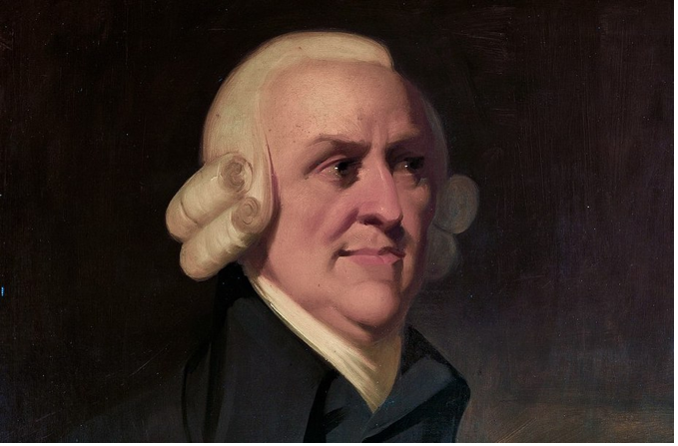
Figure 1 Portrait of Adam Smith. Source: George Alogoskoufis, “Adam Smith (1723–1790),” The Ideas of Economists, April 2, 2022, https://ideasofeconomists.com/2022/04/02/adam-smith/.
In order to understand this apparent paradox, I will examine Smith’s Lectures on Rhetoric and Belles Lettres, delivered at the University of Glasgow in 1762–63; his essay “Of the Nature of That Imitation Which Takes Place in What Are Called the Imitative Arts,” from around 1795; and his two most famous works, The Wealth of Nations (1776) and The Theory of Moral Sentiments (1759). My analysis draws on these writings to argue that music succeeds not merely because of its intellectual value, but because of its social and emotional utility. By means of its sensory immediacy, music becomes both socially generative and economically productive.
In the Lectures on Rhetoric and Belles Lettres, and in his “Of the Nature of That Imitation Which Takes Place in What Are Called the Imitative Arts,” Smith classifies music as an inferior art in relation to fine arts such as painting and poetry. This is due to music’s lack of referential meaning, in that music does not imitate external objects the way that other forms of art do. As Smith argues, “the proper pleasure which we derive from those two imitative arts [i.e., painting and poetry] . . . is founded altogether upon our wonder at seeing an object of one kind represent so well an object of a very different kind.”1 This passage highlights that aesthetic pleasure and meaning in the imitative arts depend on the representation of perceptible objects, a capacity that music notably lacks. Though this argument applies to all music, it is more specific to instrumental music. At its core, instrumental music does not represent an external object; it has no story, no object of reference, no narrative, and does not represent any fathomable natural phenomena; it is nothing but an abstract combination of sounds. According to this criterion, then, music cannot be justified by reason or by interpretations of its meaning after it is initially perceived. Unlike poetry or painting, which exist in a wider spectrum and are open to interpretation as they relate to a story, an object, or nature, music essentially exists within a self-sustaining vacuum. In other words, music is to be perceived in the moment, and left in the moment in which the senses perceive it.
Nonetheless, Smith depicts music as systematically organized and intellectually satisfying. First, it creates an “immense variety of agreeable and melodious sounds”; these sounds are arranged, or, as musicians might say, placed into an appropriate “form” which listeners perceive. This is an ever-repeating process that only happens the moment the music is heard, not after. Smith describes artistic systems as producing pleasure through order, method, and regularity, which explains, in his view, why structured musical patterns create intellectual satisfaction for the listener.2
However, this process brings an aspect to the experience of music that other art forms do not: the production of both sensual and intellectual pleasure. For Smith, music is, to put it simply, an arrangement of pretty notes––comparable to ikebana, the arrangement of flowers––from which sensual pleasure is derived. The systematic nature of music gives rise to logical pleasure too. The mind enjoys mental stimulation, and this pleasure is almost guaranteed when the object of contemplation presents itself as a coherent and ordered system, allowing the observer to perceive patterns and anticipate progressions.3 Bluntly put, it’s the listener’s ego being stroked by a correct prediction of the next line of melody.
While other arts rely on the imitation of external objects and tend to produce mostly delayed pleasure, music produces immediate pleasure, often more intense than that provided by other arts. However, in the imitative arts, if the art is merely copying its object, then it has no artistic value; the key to value, for Smith, lies in the manner of representation rather than what is represented. Thus these arts derive their value from their representational qualities. For instance, the value of a sculpture is tied to its referenced objects; meanwhile, for painting, the value is in making ordinary objects interesting. However, these arts’ quality still relies on external objects.4
Smith also argues that aesthetic value, and the pleasure that comes with it, inheres in mental activation. This mental activation stems from an emotional response to novelty and unexpectedness, evoking wonder and admiration. To further explain this idea, he asserts that the mind classifies objects automatically, but when it finds itself unable to do so the imaginative faculties are activated, producing cognitive disruption. Furthermore, the mind builds expectations, and surprise occurs when patterns of expectation are broken. He concludes that pleasure is the tension that arises between expectation and disruption.5
Smith further suggests that, though music is not imitative, it can provide the same effects as the imitative arts, if not stronger ones; music avoids imitation entirely but achieves the same result.6 Listening requires attention and the tracking of patterns. This leads the mind to anticipate structure and to experience intellectual pleasure. Such pleasure stems from cognitive recognition, which happens when the listener predicts an oncoming musical sequence; when correct, the listener is satisfied.7 The mental process is fortified by repetition, which reinforces patterns and strengthens expectations. Music therefore provides intense sensory, intellectual, and emotional stimulation, while requiring minimal effort compared to other arts, making it a high return on experience; it is low cost yet high reward. Though music lacks imitation, it maximizes emotional response and cognitive stimulation; thus, though it is aesthetically “low,” on the level of experience it achieves more than other art forms because it arouses the mind more so than the representational arts.
Within the same essay on imitation, Smith argues that, though music cannot describe the meanings emotions hold in the same way that poetry does, it imitates how emotions sound and feel; thus he classifies music as an art of affective imitation rather than one that represents a preexisting object or state of being. In this way, Smith establishes that music operates at the level of emotion rather than ideas. Music, he writes, imitates “the tone and the language of counsel and conversation, the accent and the style of emotion and passion.”8 Smith goes on to describe emotions as repetitive, haunting, intrusive, persistent, and cyclical. Human emotions are not linear; they loop and repeat until they are eventually resolved, much like music through its repetitions. This is comparable to the ways that a piece of vocal music might repeat the same phrase, with each repetition increasing in intensity, until a resolution is reached, both lyrically and harmonically. Smith observes that in strong emotion there is “one thought or idea which dwells upon [a man’s] mind, which continually haunts him, which, when he has chased it away, immediately returns upon him.”9 The passion that music imitates cannot be recreated by any other art; the passion that comes from repetition is not tolerated in other arts, such as poetry, which depends on the progression of ideas and in which repetition becomes tedious. As such, because music does not demand the same variety and progression as the literary arts, it can repeat the same idea without tiring audiences. The result is a more accurate representation of the range of human emotions. As Smith remarks, “Music frequently produces its effects by a repetition of the same idea; and the same sense expressed in the same, or nearly the same, combination of sounds though at first perhaps it may make scarce any impression upon us, yet, by being repeated again and again, it comes at last gradually, and by little and little, to move, to agitate, and to transport us.”10 Smith thus demonstrates that repetition is not a limitation in music but the means through which it achieves emotional intensity.
To sum up, unlike poetry and painting, which in Smith’s view sit higher in the hierarchy of the arts because they facilitate further contemplation after the mind’s immediate perception, music bypasses reasoning and interpretation, enabling the mind to perceive the sound and experience the intended emotion directly during this perception.11 In other words, in terms of the aesthetic process, the start is the same, and the end is the same, but music skips the steps in the middle. One can argue therefore that music is the most efficient art because it produces emotional and cognitive effects simultaneously rather than sequentially. However, there is one extra step that listening to music achieves: promoting social cohesion and mutual sympathy. The emotions evoked in the listening experience are what Smith describes as mutual human experiences or, more accurately, common human emotions, which bind society together.12
To understand and gain perspective on the significance of mutual human experiences in Smith’s philosophy, as well as the role of emotion in creating social bonds, Smith’s better-known works are to be explored. Smith describes the role of mutual sympathy in his Theory of Moral Sentiments, specifically in part 1, “Of the Propriety of Action,” in which he argues that emotional experience is fundamentally social. As Smith writes, “How selfish soever man may be supposed, there are evidently some principles in his nature, which interest him in the fortune of others.”13 While his Machiavellian or classical-realist predecessors had argued that humans are purely self-interested, Smith takes the opposite stance and suggests that humans are naturally affected by others and drawn to their emotions; he believes this is part of our basic human nature. Though we cannot directly feel others’ emotions, we can nevertheless experience sympathy. Smith explains that “it is by the imagination only that we can form any conception of what are [another’s] sensations.”14 It is the act of sympathy––the individual imagining themself in their counterpart’s situation––that forms a shared emotional experience, and though we cannot feel someone else’s emotions in their place, we can feel with them. As Smith states, “By the imagination we place ourselves in [another’s] situation, we conceive ourselves enduring all the same torments, we enter as it were into his body, and become in some measure the same person with him, and thence form some idea of his sensations.”15 This proposed framework applies to all emotions, including sadness, gratitude, joy, anger, and frustration. These emotions are reactive, making them quick and automatic, almost a kind of projection.
This is where music’s value lies: Music that produces emotions immediately can automatically elicit sympathy, in which the emotional experience is shared, and, as emotions are immediate within an individual, the concert hall becomes a place where emotions are instantly exchanged. Smith notes that “the emotions of the bystander always correspond to what, by bringing the case home to himself, he imagines should be the sentiments of the sufferer.”16 Furthermore, the concert hall is the ideal environment for mutual sympathy to arise and flourish, and this mutual sympathy is of the utmost satisfaction to the individual experiencing it, not because of the emotion itself, but because the individual is not alone in this emotionally exposed and vulnerable state.17 Individuals are “sensibly relieved” when their emotions are shared with others. Smith explicitly states that “nothing pleases us more than to observe in other men a fellow-feeling with all the emotions of our own breast.”18
The Theory of Moral Sentiments is notable for its depiction of shared human nature and its use of musical terminology in this depiction. Smith first broadly defines sympathy as a shared feeling, given that, as a fundament of human nature, it is a coordinated emotional alignment. If to feel is to experience an individual emotion, sympathy is a joint experience. In his writing, Smith uses the word “ours” deliberately, aiming to shift from the individual to the collective.19 He then describes the collective in musical terms, using words and phrases like concord, unison, beat time, and harmony. He depicts harmony as the emotional alignment between individuals, and “happy commerce” as friendship and social exchange. When Smith invokes “beat time,” he refers to people seeking emotional synchronization, in which timing matters because emotions must align simultaneously. He also implies that social interaction is a coordinated performance, such that conversation aligns sentiments and produces harmony, and that emotional alignment leads to stability and order.20 Furthermore, he notes that society will never be in unison, but rather in concord, meaning that society does not require identically shared emotions; rather, it needs compatible alignment.21
Smith’s model of sympathy can be extended to account for what happens in the concert hall. According to his musical analogies, music becomes a model of social interaction: Shared emotion causes harmony or cohesion, resulting in a social bond. His preferred word here, “rhythm,” emphasizes that these emotions are structured in time, making the concert an ideal environment for emotions to synchronize. He also asserts that conversation produces harmony, and that without harmony there is disorder; therefore, sympathy is foundational to social order. In his musical analogies, harmony is what musicians know it to be: different notes that collaborate toward a pleasant result. However, in the context of human nature, harmony is emotional alignment that causes social cohesion; it is, too, a coordinated difference. Consequently, music structurally enables a social experience.
Smith further argues in his Theory of Moral Sentiments that, if others do not share emotion or mutual sympathy, then the emotion feels wrong or uncomfortable; thus, people seek environments where sentiments are shared, rendering emotion increasingly strong and vivid rather than a nuisance or inconvenience.22 He later states that humans want to share emotion rather than experience it in isolation, making emotion a social drive.23 In this sense, concerts are simply a form of amplified emotional experience, and attending and participating in music culture satisfies the human drive toward shared emotion. Smith also adds that social interaction stabilizes emotion and enhances sympathetic exchange, and that as those processes take hold so does social cohesion. “Society and conversation, therefore, are the most powerful remedies for restoring the mind to its tranquility, if, at any time, it has unfortunately lost it.”24 Thus music strengthens the bonds holding society together, and because of the pleasure shared emotions bring––making one feel a sense of serenity and peace after initial perception––one is certain to seek out shared musical experiences again.
What further cements this bond is the growth of a public sphere. As mentioned, the mutual emotional experience does not end at the concert. It is extended and processed socially in the public sphere, which includes coffeehouses, salons, taverns, and voluntary associations such as Masonic lodges. These spaces facilitate the emotional experience of music becoming an object of discussion, which is then circulated through discourse, such that private experiences are embedded in public deliberation. The public sphere allows discussion to move beyond the household, encompassing topics such as art, economics, politics, and more.25 In addition, coffeehouses serve as sites of rational discourse, where ideas and experiences are exchanged and interpreted. What made coffeehouses unique, in Smith’s time, was that class hierarchy was temporarily suspended in them (at least in theory), with the barrier to entry into conversation reduced to the ability to buy a drink, which many could afford. This enables greater participation in discussion, which was additionally facilitated by the reading materials such as newspapers, journals, books, and pamphlets that coffeehouses would provide.26
Music falls naturally into the category of conversation and public discourse. As music becomes a subject of discussion and debate, Smith contends, individuals share perspectives on concerts, operas, their interpretations of the works being presented, and such works’ value. This allows music to be an object of public opinion, as emotional reactions to concerts are to be shared and discussed. Additionally, music becomes integrated into everyday life because, as the public sphere became more accessible across social and economic classes in Smith’s day, emotional responses to concerts were communicated through shared conversation. Furthermore, because individuals could relate to one another’s interpretations and emotional responses, mutual sympathy spread among audiences from the concert hall to the public sphere, reinforcing emotional alignment of the kind considered above. Likewise, because the public sphere provided print media for consumption and circulation, including music journalism and concert announcements/advertisements, the discussion of music spread beyond concert attendees. Such discussion would be repeated, enabling taste and standards to form and according to which public opinion would influence what is regarded as desirable, and what people want and demand.
Smith’s most celebrated economic theory, laid out in The Wealth of Nations, provides a useful framework for accounting for the rise of public music concerts in Enlightenment contexts. It is worth noting that, in Smith’s time as well as our own, participation in music culture and its discussion in public contexts requires discretionary income; a common axiom holds that having more discretionary income signals a higher quality of life, which would entail more money to spend on cultural consumption, including music consumption. Public-sphere activity reflects economic capacity. Moreover, public conversations increase the visibility and awareness of cultural phenomena, with the effect that people hear more about upcoming concerts and performers, and more wish to attend these events. Because the public sphere amplifies discussion about objects of culture, musical activity proliferates, and demand increases further.
In the second half of the eighteenth century, music was not only an art and a cultural activity, but also increasingly an economic good and a commodity with financial value, bought and sold. As Rosamund McGuinness has argued, music consumption was normalized through regular concerts that were central to urban social life.27 Such concerts were social events, belonging to the emergent public sphere, and functioned as social meeting spaces where audiences attended to participate in a shared experience.28 This development reinforced Smith’s characterization of mutual and shared sympathy as a social interaction. The Enlightenment saw a large-scale expansion of concert activity, with more frequent public performances and concert series, making music broadly available to consumers and creating a large and active market. Music also extended beyond performance into industry, which included production, manufacturing, maintenance, distribution, printing, and more.29 This supports Smith’s division of labor, which is the larger unit of specialization.
Music marketing flourished in the new public sphere, with concerts advertised in newspapers (figure 2), which circulated in coffeehouses.30 Music was presented as a status symbol, desirable and prestigious, so that attending concerts was seen as socially valuable.31 In addition, marketing was able to create, reflect, respond to, and increase demand, thereby forming a feedback loop. It also furnished an emotional desire for music as a commodity and encouraged participation in music culture.32
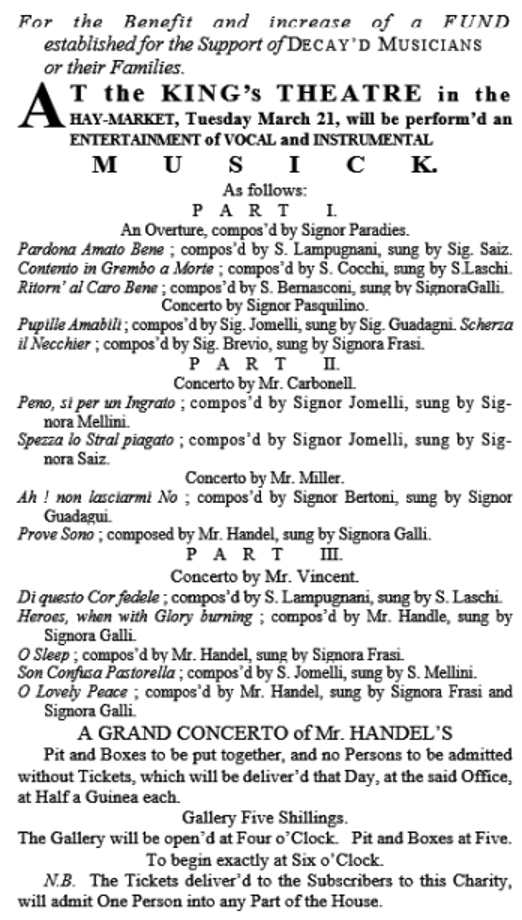
Figure 2 Example advertisement, specifically for a benefit concert. Published in the General Advertiser, March 14, 1749. Drawn from Catherine Harbor, “The Marketing of Concerts in London 1672–1749,” Journal of Historical Research in Marketing 12, no. 4 (2020): 453.
Some further context is necessary here. In the Enlightenment, the rise of commercial society marked a shift in how wealth was understood and how people consumed cultural goods. Enlightenment economic thought helped create the conditions for increased music consumption and demand. Wealth came to be understood in terms of productive capacity––people and their skills––rather than merely the possession of money, and the middle class emerged as a key consumer group.33 It is well known that the Enlightenment was an intellectual movement in which education was recognized as a means of improving society; this in turn contributed to a rise in employment opportunities, equipping more people with the capacity not only to provide for their lives but also to enjoy them. As the economic structure and attitudes toward wealth changed, the quality of life changed too, in turn shaping patterns of cultural consumption. With the rise in spending on culture during the Enlightenment, the quality of life improved even further, suggesting that disposable income increased as well. In relation to music, the Enlightenment witnessed a rise in specialized, trained musicians, performers, and composers, not to mention middlemen such as instrument makers, music publishers, and concert promoters, thereby tying music making to divided labor and increasingly specialized skills. The result was a self-perpetuating cycle: The refined arts increased sociability, which increased discussion, which refined taste, and in turn created greater demand for the arts.
Book 1 of The Wealth of Nations describes the ways that the division of labor and specialization enable markets. Smith explains that Enlightenment society was producing more goods not because individuals had become more talented, but because labor was more organized and specialized, which is the foundation of commercial society and industry. As Smith writes, “The greatest improvement in the productive powers of labour, and the greater part of the skill, dexterity, and judgment with which it is anywhere directed, or applied, seem to have been the effects of the division of labour.”34 What the division of labor achieves is increased efficiency, specialization of a skill or craft, and individuals’ interdependence on one another,35 as even the simplest goods require “the joint labour of a great multitude of workmen,” which also explains the greater output of goods.36 Smith attributes this increase in output to “the increase of dexterity in every particular workman; secondly, to the saving of the time which is commonly lost in passing from one species of work to another; and lastly, to the invention of a great number of machines which facilitate and abridge labor, and enable one man to do the work of many.”37 On the logic of specialization, Smith argues that by breaking production into stages, each with an individual most skilled for that stage, output increases exponentially. However, this also results in a structural change from craft to industry.38
At this stage in his argument, Smith introduces one of his most important ideas: Specialization, he contends, is able to occur only if there is sufficient demand. In a smaller market with little division of labor, there is little specialization; in a larger market with more specialization, complex industries emerge. Furthermore, Smith claims that the resulting markets arise from human nature: Humans seek cooperation and rely on exchange, making them dependent on one another. Within this depiction of human nature, Smith explains the drive of production, such that producers respond to incentives, and supply follows demand. He then clarifies that exchange creates value, proposing that markets are based on mutual benefit and perceived value. As Smith famously writes, “It is not from the benevolence of the butcher, the brewer, or the baker, that we expect our dinner, but from their regard to their own interest.”39 His final major theoretical insight is that, through the division of labor, more goods are produced, thereby broadening availability. In effect, as production increases, prices decrease, and levels of accessibility expand. Smith argues that the division of labor produces “a general plenty [which] diffuses itself through all the different ranks.”40
Book 1 of The Wealth of Nations is directly relevant to what scholars have observed about music in Enlightenment contexts. In this book, Smith argues that the division of labor can be seen as the structural basis of cultural production. Prior to Smith’s time, most music making was either private, happening in court contexts, or ecclesiastical, happening in churches. Trained musicians were responsible for improvising, composing, and performing their own music, as well as for tuning and maintaining their instruments, and for teaching. Opera represented only a partial exception to this. However, in Smith’s time, music was becoming a structured industry supporting a vast array of professions, including composers, performers, instrument makers, venue operators, and more. Smith notes that “the separation of different trades and employments from one another, seems to have taken place, in consequence of this advantage” in advanced societies.41
Smith’s logic of specialization directly applies to the scalability of music: Instead of one person accomplishing everything, orchestras were collective labor, opera production was multitiered labor, and music printing, publishing, instrument making, and concert organization all involved significant divisions of individual tasks and skills. As music became more scalable, it also became something that could be replicated, reproduced, distributed, and commercialized.
To tie this argument together across Smith’s aesthetic, social, and economic writings: Smith argued that music produces emotion, mutual sympathy, collective experience, and social bonds in his Theory of Moral Sentiments and his Lectures on Rhetoric and Belles Lettres; in The Wealth of Nations, he says that demand determines production, an argument that relates to music as to other commodities. The implication is that what music uniquely achieves, which other art forms fail to do either as a whole or as efficiently, is exactly what creates high demand. Production and supply match this demand, leading to music’s immense commercial success. In addition, music represents the human nature of exchange as a social behavior, and because music provides emotional stimulation and furnishes social belonging, it is an experience people are willing to pay for, thereby driving cultural production. In this sense, music becomes an early form of the “experience economy,” in which consumers are paying not for material goods but rather for the emotional and social experience.
What we learn from studying Enlightenment aesthetic thought is that music was generally considered the “lowest” art because it lacks imitation and referential meaning. However, by observing the real historical contexts of the Enlightenment Era, we see that music achieved unprecedented commercial success during this time. Nonetheless, this phenomenon is not a contradiction but a result of its unique emotional, social, and economic functions. Adam Smith, one of the most prominent philosophers arguing for music’s low status, asserted that music produces immediate sensory pleasure without requiring subsequent interpretation. But music also produces intellectual pleasure by engaging the mind through pattern recognition, expectation (of patterns), and surprise. Overall, music provides rich emotional and cognitive stimulation with minimal effort, thus making it unique among the fine arts by bypassing the interpretation stage that occurs after the initial perception of other art forms, like literature or the visual arts. Smith further argues that music generates mutual sympathy, or, in other words, a shared emotional experience. By extension, we may see public music performances such as concerts as spaces of emotional synchronization, in which shared emotion results from social bonding and cohesion. This social function of music allows individual feelings to be transferred into a collective experience, or, as Smith calls it, mutual sympathy.
The emotional experience of music then extends into public discussion, facilitated by the flourishing the public sphere, such as coffeehouses, taverns, and salons, which also circulate media related to music, such as advertisements and reviews. Discussion in the public sphere helped spread awareness, shape taste, and stimulate a desire to participate in music culture, including by attending concerts, operas, and other performances. The public sphere facilitated public discussion, which led to increased demand through social circulation, or “free advertisement,” so to speak. What distinguishes the Enlightenment from earlier eras is the rise of an educated middle class and the corresponding rise in disposable income that axiomatically fed an increase of cultural consumption.
To conclude, when we read Adam Smith’s work as a window into the apparent paradox of music’s low aesthetic status yet immense commercial success, it becomes clear that music succeeds not because of what it lacks according to Enlightenment Era aesthetic theory, but what it creates in value. Music makes individual emotion into shared experience, which then leads to discussion, that later inspires others and creates demand, which finally facilitates market expansion: the marker of commercial success. I have argued here that music functions as a good within an early “experience economy.” Overall, though music may be regarded as an art of low aesthetic rank, it demonstrates Smith’s broader idea of value: the ability to engage human nature rather than merely human reason.
- Adam Smith, “Of the Nature of That Imitation Which Takes Place in What Are Called the Imitative Arts 1795,” in Eighteenth-Century British Aesthetics, ed. Dabney Townsend (Routledge, 1999), 448.↗
- Smith, 463.↗
- Smith.↗
- Maria Semi, Music as a Science of Mankind in Eighteenth-Century Britain, trans. Timothy Keates (Ashgate, 2012), 94.↗
- Semi, 95.↗
- Semi, 99.↗
- Semi, 100.↗
- Smith, “Nature of That Imitation,” 452.↗
- Smith, 453.↗
- Smith.↗
- Smith, 454.↗
- Smith, 455.↗
- Adam Smith, The Theory of Moral Sentiments, ed. Knud Haakonssen (Cambridge University Press, 2012), 11.↗
- Smith.↗
- Smith, 12.↗
- Smith, 13.↗
- Smith, 14.↗
- Smith, 17.↗
- Daniel Klein and Michael Clark, “The Music of Social Intercourse: Synchrony in Adam Smith,” Independent Review 15, no. 3 (2011): 414.↗
- Klein and Clark, 415.↗
- Klein and Clark, 416.↗
- Smith, Theory of Moral Sentiments, 17.↗
- Smith, 18.↗
- Smith, 28.↗
- Michael Schaich, “The Public Sphere,” in A Companion to Eighteenth-Century Europe, ed. Peter H. Wilson (Blackwell, 2008), 125.↗
- Schaich, 127.↗
- Rosamond McGuinness, “Gigs, Roadies and Promoters: Marketing Eighteenth-Century Concerts,” in Concert Life in Eighteenth-Century Britain, ed. Susan Wollenberg and Simon McVeigh (Routledge, 2004), 261.↗
- McGuinness, 262.↗
- McGuiness, 263.↗
- McGuiness, 262.↗
- McGuiness, 263.↗
- McGuiness, 266.↗
- Kathryn Sutherland, “The New Economics of the Enlightenment,” in The Enlightenment World, ed. Martin Fitzpatrick et al. (Routledge, 2004), 474.↗
- Adam Smith, The Wealth of Nations: An Inquiry into the Nature and Causes of the Wealth of Nations (W. Strahan and T. Cadell, 1776; repr. NetLibrary, 2000), 3. Citations refer to NetLibrary reprint.↗
- Smith.↗
- Smith, 8.↗
- Smith, 5.↗
- Smith, 4.↗
- Smith, 8.↗
- Smith, 7.↗
- Smith, 5.↗