
In 1800, John Neilson (figure 1) published Le graduel romain à l’usage du Diocese de Québec, a 660-page compilation of liturgical chants transcribed in square notation (figure 2).1 The volume contains the first published music in Canada. This source has been studied as an artifact of Canadian plainchant and music publishing, respectively, but it is also a fascinating document of the religious landscape of colonial Canada and the trans-Atlantic circulation of Enlightenment values. In the wake of the Treaty of Paris in 1763, and in the face of revolution in its southern thirteen colonies, Britain passed the Quebec Act of 1774, marking a point of religious tolerance that allowed for Catholic worship, made it possible for Catholic men to hold political office without swearing an oath to the Church of England, and sanctioned the practice of French civil law, rather than English, in the colony. Published by a Presbyterian man who married a Catholic woman and supported the preservation of French culture and Lower Canada, Le graduel romain is an intriguing artifact of early music printing and of Catholic tolerance in the nascent country of Canada.
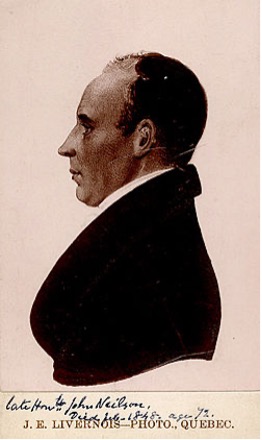
Figure 1 Profile of John Neilson. Quebec National Archives.
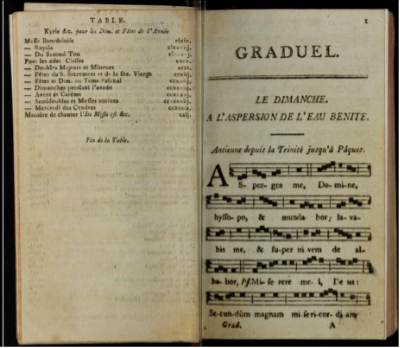
Figure 2 Page one of Le graduel romain. The chant printed is a setting of Asperges me. The book lists it as the antiphon sung from Trinity Sunday to Easter. Above the setting appears the text: “For Sunday, at the sprinkling of holy water” (“Le dimanche. A l’aspersion de l’eau benite.”).
Le graduel romain has 431 pages of mass chants for feasts of the Lord (Propre du temps) and 214 pages of chant for feasts of individual saints (Commun des saints) and for the Ordinary of the Mass. Neilson announced his intention to publish the first music book in Canada on November 24, 1797, on the condition that four hundred subscriptions for copies would be collected before publication.2 At the time, parishes in the Quebec diocese used liturgical volumes imported to the colony from France.3 Neilson advertised his own liturgical book to conform to the great liturgical books of Lyon. In doing so, he followed the Quebec diocese’s tendencies to work in the image of French dioceses.4 Neilson printed the music with square notation on four-line staves with text with movable type.5 In the preface, he recognizes the historical significance of his book, acknowledging the scarcity of chant books in the Quebec diocese, and mentions that those in existence at the time are inconsistent with each other. Because of this, he wrote that younger people were no longer learning the chants, to the detriment of the majesty of the Divine Liturgy.6 In the following years, Neilson published Le processional [sic] romain (1802), Le vesperal romain (1802), and Extrait du processional [sic] romain (1819).7
Before the publication of Le graduel romain, most liturgical chant books were imported to Quebec from France. As Jean-Pierre Pinson has shown, these books reflect a diverse practice, in part because they come from different regions in France with differing plainchant traditions, and because institutions, circumstances, local feasts, and knowledge of chant caused the practice to oscillate between dicere chant and cantare chant.8 Liturgical chant books by Paris musician Guillaume Gabriel Nivers (1632–1714), like the Graduale romanum, were brought from France and used in the Quebec Seminary, as well as by the Ursulines. They were notated with squares and diamonds to indicate duration, and with vertical bars to indicate the midpoints and endings of lines. The Augustine and Benedictine orders brought their own type of chant to New France, where the chants were notated and composed with augmentations, like trills and appoggiaturas.9 The books from New France studied by Pinson cover both an essential and local repertoire from the oldest to the most modern chants. Many of them have inconsistent notation and ornamentation across each other. The music written supports the chanted text but depends on the capacity and freedom of the cantor. The diocese of Quebec worked in the image of French dioceses. It imported its books and practices from the churches in France. By publishing a volume conforming to the churches in Lyon, Neilson’s compilation reflects Quebec’s emulation of French practices.
Rather than import all books from Europe, music publication in Canada began to fill the colonists’ local needs for hymnbooks and tutors. Music printing was expensive and challenging. Typesetting, a method of printing used for Le graduel romain, was commonly used. Publishers owned the basic printing equipment and knew the method but had to acquire the music type. An average of four hundred different characters in multiples were necessary to prepare four pages of music at a time. Knowledge of music and attention to detail were essential to producing accurate volumes.10 Because certain combinations of musical font were required to produce the desired notation, mastering the craft could take apprentices several years. With stiff competition caused by imported books from the American and European markets and expensive type that easily wore down, one wonders why Canadian publishers troubled themselves with printing music. Most of the books printed in Canada included contributions written or compiled by Canadians,11 making the material significant. In this way, printing and publication could create or preserve a national and religious identity.
As a Catholic book of worship, Le graduel romain could not have been published in a British colony without the passing of the Quebec Act. In 1774, the British Parliament passed the Quebec Act and replaced the temporary administration established by the Royal Proclamation of 1763. The act allowed for the practice of French civil law, promised a representative elected assembly, and secured freedom of worship for Catholics, allowing them to hold public office using an oath that did not refer to the Church of England. The act reestablished compulsory tithing to benefit the Catholic episcopate and Jesuits.12 It also challenged Whig beliefs about the British Protestant state and its empire, and aroused fears about tyrannical Catholic rule among Protestants. However, in light of the American Revolution, and considering that the French Catholics outnumbered the British in Quebec, British generals in the colonies convinced their peers in British Parliament that it was politically expedient to tolerate Catholics in the hopes of encouraging their loyalty to Britain.13 Some generals, like James Murray, also saw tolerance as an opportunity for the Catholics to convert to Anglicanism.14 From 1600 to 1760, the Catholic Church in Quebec was primarily focused on evangelizing and educating the public, setting up parishes, missions, and religiously affiliated institutions such as schools, seminaries, and hospitals. However, many of these were destroyed or weakened by British rule starting in 1760. The Quebec Act allowed conditions to improve for Catholics, but it was not until the 1830s that the Canadian Church would gain its footing.15
One might think that the publisher of a Catholic hymnal in Quebec would be a French Catholic. Neilson was not. Born in Scotland in 1776, he arrived in Quebec City in 1791 and began to work for his uncle, William Brown, in the latter’s print shop. In 1764, Brown cofounded (with Thomas Gilmore) a bilingual, politically independent newspaper called the Quebec Gazette. Neilson inherited the Quebec Gazette in 1796 at the age of twenty.16 In 1800, at twenty-four, he printed Le graduel romain. He was a Presbyterian man, and yet, he printed Catholic chant books and sold Catholic prayer books in his bookshop.17 Why?
Neilson believed strongly in the cooperation of French Catholics and British immigrants. In 1797, he had married a Catholic woman named Marie-Ursule Hubert, who was the niece of the Catholic bishop of Quebec, Jean-François Hubert. Neilson wished both to symbolize his permanent establishment in Canada and to lessen prejudices between British immigrants and Canadians. Curiously, he raised his sons Presbyterian and his daughters Catholic. While he regularly attended St. Andrew’s Church in Quebec City and was even commemorated with a plaque there, he also had a pew in the Catholic parish of Quebec, which he paid for regularly.18 Neilson was also an active politician who sympathized with French Canadians and wished to protect their independent identity. In 1818, he became a deputy to the Legislative Assembly for the Parti canadien. A moderate reformer, he supported a greater balance of power, including more accountability of the Legislative Assembly, and opposed the absolute authority of government or councils. He believed strongly in the British connection and traveled to London with Louis-Joseph Papineau to negotiate with parliament. He opposed the union of the Canadas because of his concerns for the negative consequences to the French Canadian population and culture. However, he fell away from his party when it became more radical in its opposition to the union of the Canadas.19 Given that he advocated for the preservation of French Canadian culture in parliament, he may have printed Catholic worship materials as a natural extension of that advocacy.
Brown, Neilson’s uncle, ran a print shop that may have been tolerant of Catholics, or that simply capitalized on the market. Neilson inherited this print shop, along with whatever values or customers his uncle had cultivated. After the Seven Years’ War cut off the supply of books to French Canada, a market for Catholic devotional books opened within the colony. Brown and Gilmore (his business partner) were based in Philadelphia where they had learned the printing trade. They moved from Philadelphia and capitalized on this new market by publishing the first catechisms in Quebec.20 Whether Brown and Gilmore were religiously tolerant or simply saw a good business opportunity is up for speculation; however, Neilson continued to print and sell Catholic works, as did his (Presbyterian) sons. His son Samuel continued to publish editions of Le graduel romain and the other Catholic liturgical books, and when William Neilson, John’s second son, inherited the shop, he published Catholic works as well as Aiamie Kushkushkuta Mishinaigan (1847), which is possibly the first Indigenous-language hymnbook with musical notation published in Canada.21 More research is required to determine the significance of these publications; still, I conclude that the Neilson print shop––whether for commercial gain or as a symbol of unity––was not exclusivist. Note Le graduel romain, Le grand catéchisme, and the Catholic prayer books listed in the figures below taken from a catalog of books, imported from London and sold in Neilson’s shop (figure 3).
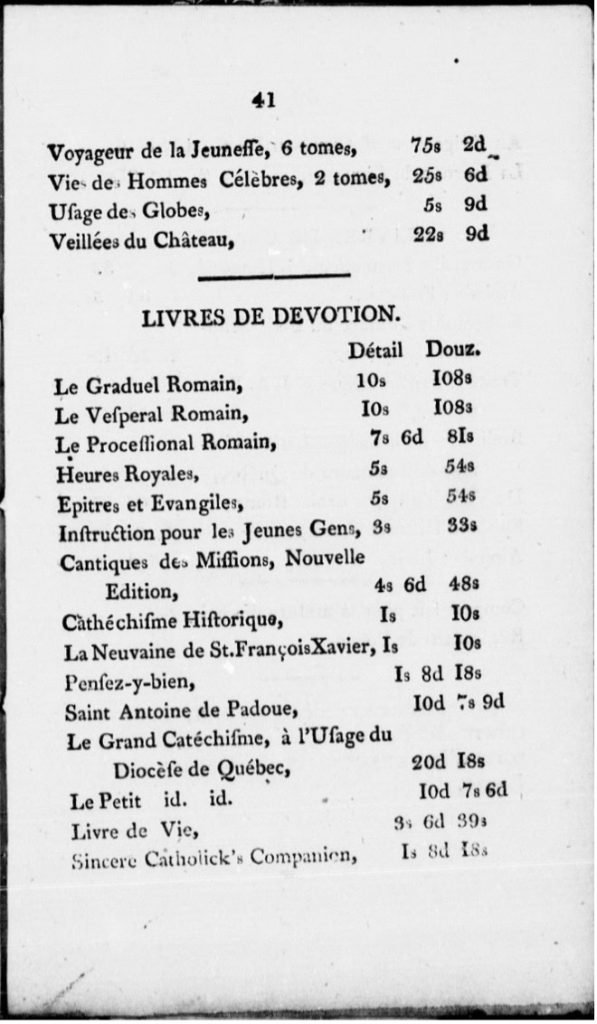
Figure 3a Neilson, Catalogue of Books, Imported from London, and for Sale at J. Neilson’s Shop, No. 3, Mountain Street, Quebec (Publisher not identified [Quebec?], 1811), 41.
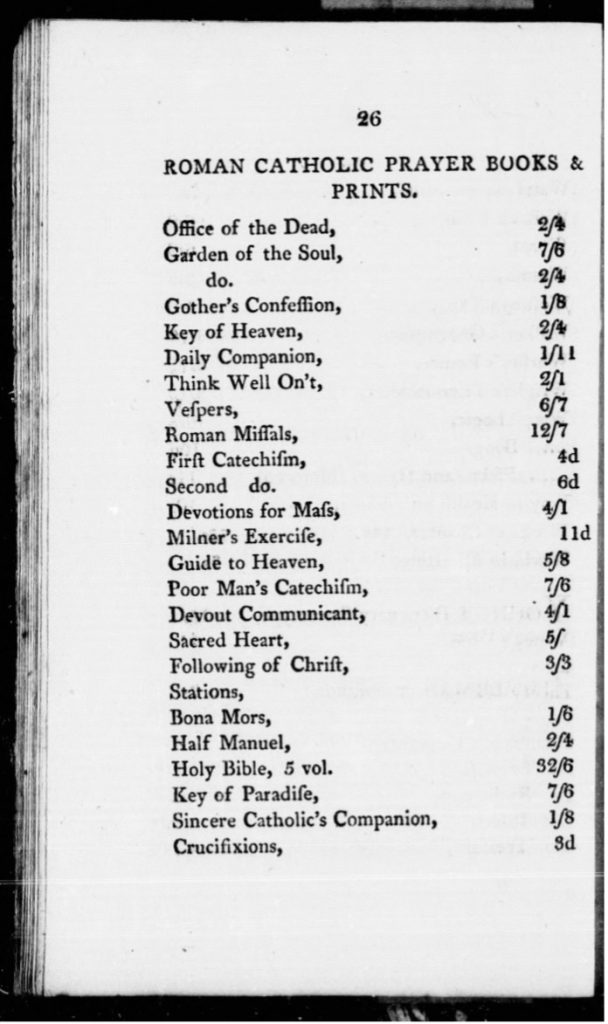
Figure 3b Catalogue of Books, Imported from London, and for Sale at J. Neilson’s Shop, No. 3, Mountain Street, Quebec (Publisher not identified [Quebec?], 1811), 26.
Neilson’s tolerance of Catholics is congruous with Enlightenment values of religious tolerance and the emergence of the public sphere. Melanie Lowe argues that two centuries of religious violence fatigued nations, and that instead of persecuting those who practiced non–state sanctioned religions, they decided to tolerate them.22 This tolerance was both economically pragmatic, as exemplified by Brown and Neilson’s profit from selling Catholic books, and politically useful, as exemplified by the British generals’ tolerance of French Catholics. Lowe writes that once tolerance was accepted as a societal ideal, the public sphere began to emerge, where such tolerance was practiced for the purposes of intellectual civil conversation.23 Given that he married a Catholic woman, Neilson’s religious tolerance seems to go beyond what was normal for eighteenth- and nineteenth-century society; however, he lived in a society influenced by Enlightenment values that encouraged religious tolerance for the sake of maintaining and bolstering an intellectual public sphere.
Daniel Heartz describes the Enlightenment as a movement dedicated to raising levels of general education and preoccupied with human betterment. As an example, he underscores the German and Austrian movements to found various “national” theaters to improve society and circulate the vernacular language.24 As the middle class consolidated, its demand for public spaces hosting cultural and intellectual exchange grew. Large theaters were built to house larger audiences, and music was composed for a mainly middle-class audience––for example, Handel’s oratorios.25 In 1652, Europe’s first coffeehouse opened in London, starting a wave of coffeehouses throughout Europe. By 1715, London and Paris each had several hundred coffeehouses, where men, and sometimes women, could gather to discuss their opinions.26 Belief in the wide dissemination of knowledge supported the development of libraries like the Bibliothèque Mazarine in France (1643), and the British Museum and Library (1753). Increasingly, these libraries transitioned from being private libraries to “subscription” libraries, in advocacy of universal literacy.27
Neilson’s print shop and its offerings reflect the Enlightenment values of literacy and education, which had been developing in Quebec City from the 1770s onward. In 1779, amid the American Revolution, Governor Sir Frederick Haldimand called for the construction of the Quebec Library, the first subscription library in Canada. The idea of a free press was considered characteristic of liberated Britons, as men could think for themselves, but Governor Haldimand also sought to educate the public, share useful knowledge, and bring together French and English peoples of the colony.28 The library was held at the Anglican bishop’s palace in Quebec City, before moving to Rue Saint-Pierre in 1822.29 Like their French compatriots, literate French Canadians commonly hosted salons and discussed philosophy30 and therefore desired a subscription library. Governor Haldimand’s creation of the library contributed to the literary demand in Quebec City in the eighteenth century, which in turn influenced consumer demand for print shops like Neilson’s.
Le graduel romain, as a book of Gallican plainchant, reflects the square-notation and liturgical practices common to Quebec Catholicism in the 1800s, but it is much more than that. As a Catholic liturgical book published by a Presbyterian, it also attests to the changing political and religious views of the Quebec colony as it emerged as a new society. Discussions about the Enlightenment are often Eurocentric, focused on the movement within European countries, but neglecting their colonies. Such an oversight is detrimental to understanding how Enlightenment values shaped not only the societies where they originated, but also the societies to which they were brought. These societies were influenced by, but also further influenced, values like religious tolerance (e.g., the Quebec Act). Le graduel romain offers a new window into early Canadian society, where a Presbyterian man marries a Catholic woman and prints Catholic prayer and chant books. While many Canadians today will describe Quebec’s tensions with the rest of Canada as linguistic-based, Le graduel romain’s historical context reminds us that these tensions began in religious and national differences. Being the first published work of music in Canada, Le graduel romain is worth our attention for that reason alone. But after digging further into its provenance, the book also reveals an intriguing web of religious and political tensions in early Canadian society that echo throughout Canada today.
- Le graduel romain à l’usage du diocèse de Québec (John Neilson, 1800) (hereafter Le gradual romain). Housed at the Thomas Fisher Library Rare Book Library, B-13 03170, University of Toronto. Publicly available at “Le graduel romain à l’usage du diocèse de Québec,” Internet Archive, accessed April 14, 2025, http://archive.org/details/legraduelromainl00cath.↗
- Maria Calderisi, Music Publishing in the Canadas, 1800–1867 (National Library of Canada, 1981).↗
- Jean-Pierre Pinson, “Quel plain-chant pour la Nouvelle-France ? L’exemple des Ursulines,” Canadian University Music Review 11, no. 2 (1991): 164.↗
- Jean-Pierre Pinson and Élisabeth Gallat-Morin, La vie musicale en Nouvelle-France (Septentrion, 2003), 228.↗
- Calderisi, Music Publishing.↗
- As was written in the preface (in the original French): “On se plaint depuis plusieurs années (et avec raison) de la rareté des Livres de Chant dans ce Diocèse. Beaucoup de paroisses n’ont pu s’en procurer, jusqu’à present, autant qu’il leur en falloit pour le nombre de leurs Chantres. D’autres n’en ont que de différentes éditions qui s’accordent mal entr’elles. . . . De toutes ces causes il resulte pour le Plain-Chant un decouragement sensible, On trouve moins de jeunes-gens qui s’y appliquent, à mesure que les moyens de l’apprendre et de le pratiquer deviennent plus rares, et, par une suite nécessaire, le Service Divin ne se fait pas avec toute la décence et la majesté que l’on désireroit. Pour obvier à ces inconvéniens, nous présentons au Public une édition de Livres de Chant portatifs imprimes à Québec et conformes à l’édition des grands livres de Lyon la plus correcte et la plus récente que l’on connaisse.” Le gradual romain, a2.↗
- Calderisi, Music Publishing.↗
- Pinson and Gallat-Morin, La vie musicale, 177.↗
- Pinson and Gallat-Morin, 179.↗
- Calderisi, Music Publishing, 82.↗
- Calderisi, 17.↗
- Ashley Walsh, “The Quebec Act (1774) and the Hanoverian Church–State Relationship,” English Historical Review 140, no. 602 (2025): 103–33.↗
- Walsh, 129.↗
- James Murray, Report of the State of the Government of Quebec in Canada, June 5, 1762 (Dussault & Proulx, 1902).↗
- Pinson and Gallat-Morin, La vie musicale, 23.↗
- Pinson and Gallat-Morin, 7.↗
- John Neilson, Catalogue of Books, Imported from London, and for Sale at J. Neilson’s Shop, No. 3, Mountain Street, Quebec (Publisher not identified [Quebec?], 1811), https://www.canadiana.ca/view/oocihm.94697/50.↗
- Sonia Chassé, Rita Girard-Wallot, and Jean-Pierre Wallot, “Neilson, John,” in Dictionary of Canadian Biography (University of Toronto / Université Laval, 1988).↗
- Maxime Dagenais, “John Neilson,” in Canadian Encyclopedia (Historica Canada, 2019).↗
- Marie Tremaine, A Bibliography of Canadian Imprints 1751–1800 (University of Toronto Press, 1999).↗
- Calderisi, Music Publishing, 8.↗
- Melanie Lowe, “Difference and Enlightenment in Haydn,” in Rethinking Difference in Music Scholarship, ed. Olivia Bloechl, Melanie Lowe, and Jeffrey Kallberg (Cambridge University Press, 2015).↗
- Lowe, 138.↗
- Daniel Heartz, “Enlightenment (Ger. Aufklarung),” Grove Music Online, 2001.↗
- Heartz.↗
- John A. Rice, “Music in the Age of Coffee,” Eighteenth-Century Music 4, no. 2 (2007): 301–5.↗
- Robert Darnton, “From Printing Shop to Bookshelves: How Books Began the Journey to Enlightenment Libraries,” in The Meaning of the Library: A Cultural History, ed. Alice Crawford (Princeton University Press, 2015).↗
- Michael Eamon, “‘An Extensive Collection of Useful and Entertaining Books’: The Quebec Library and the Transatlantic Enlightenment in Canada,” Journal of the Canadian Historical Association 23, no. 1 (2012): 1–38.↗
- “Capsule historique # 2––1779: La naissance de la lecture publique au Québec (. . .), par François Séguin,” Éditions ASTED, accessed April 24, 2026, https://asted.org/francois-seguin-raconte-les-bibliotheques-du-quebec-2-2/.↗
- Eamon, “‘Extensive Collection.’”↗