Teaching, Time, and Timelines
We begin with what will be a familiar scene to some readers. We, the authors, were teaching the second of three courses in a Western music history sequence, from 1600–1800. Koval, the instructor of record, had somewhat naive aspirations to both include the canon and question it, to teach musical works that students might encounter elsewhere and expand their horizons to think about figures historically excluded, and to ground students in the comforting order of chronology while organizing topics thematically and resisting teleology. Armed with the confidence of inexperience, Koval set forth with an assignment she was sure would solve all the problems of the survey course: a crowdsourced timeline.
Using a freely available web-based software, TimelineJS, hosted by Northwestern University’s Knight Lab, students would post weekly entries to a shared timeline and discuss them in the following class. Students could draw in part from course material but also had to find their own topics from outside the syllabus, with the only stipulation being that the entries had to be from the course’s historical period and have some justifiable bearing on music history. Koval felt sure that students would be able to pursue and express their own musical interests and that the perennial problem of coverage and depth would be solved.
Koval and Comuzzo, who was Koval’s teaching assistant at the time, awaited the first entries with anticipation. What obscure music would the students unearth? What topics, people, and pieces would the students consider most important to music history? What fresh perspectives would they bring to the music history classroom? The entries began to roll in. 1678, Vivaldi is born. Another added: 1685 Handel born. Then 1714–88, the life of C. P. E. Bach. The onslaught continued: Haydn, Beethoven, Weber, Schubert. And the final nail in the coffin of the goals of the assignment: Anton Bruckner, born 1824, well outside the scope of the course. The first assignment was a complete failure. The timeline embodied the exact style of history we were trying to challenge. Instead of exercising their curiosity and individual agency, students upheld the canon, reinscribing it on a public website in the first week of class. Indeed, that first assignment was a mirror of how our well-meaning pedagogy replicated the very hierarchies we were seeking to unsettle.
Like all good failures, however, this experience was a learning opportunity for all involved. The students’ faithful attention to canonical figures offered an opportunity to reflect on what students bring to a music history survey and the kind of support they need to creatively explore their interests. We instructors were challenged to think about how exactly to foster a deeper understanding of the ways in which the lives of well-known composers intertwine with historical periods and trends, how genres are formed, and how ecosystems of people, sounds, and technological developments interconnect in the study of music history.
This article emerges from our shared and individual pedagogical attempts to reimagine the undergraduate music history survey in such a way that might equally include a robust chronology, be thematically organized, and give students agency over course content. We write from different institutional positions and our courses deal with different historical periods; however, we share a desire to foster a critical, collaborative, and curiosity-led classroom.1 Despite its initial failure, the timeline ultimately proved an effective pedagogical tool because of the many so-called “hard skills” it cultivates and in light of its potential to unsettle canonical narratives when incorporated with care. The timeline develops research skills, provides opportunities for regular, low-stakes class presentations, and encourages students to grapple with the “why it matters” question. By delivering short presentations on their timeline entries, students have a chance to pursue their own interests not only in the form of a major final assignment, but across the whole semester. As many students noted in their final evaluations, the timeline was a great way to practice presenting and arguing their points of view in lower-stakes, less formal circumstances than a final presentation.
In this article, we begin by briefly weaving together some of the discourse surrounding the musical canon as a historical form of cultural imperialism and how we can grapple with the complexity of teaching music history within colonized territories. We especially highlight the challenges facing those teaching in contexts of precarious employment and/or heavy teaching and service loads, who may not have the time or resources to overhaul a course design. We then detail our different experiences using TimelineJS in classes of twenty-five or fewer undergraduate students (including music and non-music majors) in liberal-arts colleges and a state school.
This article does not aim to present alternatives to the music-historical survey nor radical approaches to changing its structure. Rather, we offer a single teaching tool that we have both found to be effective for addressing questions of chronology, breadth, and student engagement. Our hope is to contribute to broader conversations about music pedagogy as a site of actionable social, political, and intellectual transformation. Respectively, appendices 1 and 2 provide written instructions and optional templates for creating the backend of a timeline assignment and a template assignment handout to give to students.
Teaching Within and Outside the Canon in Undergraduate Music History
The music history sequence and its canonical repertoire continue to pose difficulties to those attempting to meaningfully broaden its scope or challenge its hegemony. Whether due to a lack of resources to make sweeping changes or the canon’s continued representation in performance spaces, in many curricula a journey through the canon of musical works persists. Some choose to abandon the historical sequence in favor of a more thematic and content-inclusive approach, while others have redoubled their commitment to the sequence, arguing for its importance in giving students the tools to move forward in graduate studies or performance careers.
Margaret E. Walker, David Salkowski, Marianna Ritchey, and Alejandro L. Madrid, among others, have justly problematized the effectiveness of simply expanding what Madrid calls the “canonic fantasy” to include marginalized composers and geographic areas without truly confronting the colonial histories that are at the foundation of music institutions and value systems.2 Walker noted in 2020 that many music departments maintain Eurocentric approaches to music history that can feel out of step with the current state of the field of musicology.3 To this point, David Salkowski critiques the survey’s dependence on “grand narratives” that continue to affirm “colonialism, white supremacy, European (and later American) hegemony,” without truly interrogating these processes.4 Bluntly critiquing Western classical music institutions and their cultural imperialism, Ritchey states that “there is no need to rehash all the statistics and trot out all the graphs again; the institutional world of classical music simply is White supremacist and patriarchal.” Ritchey further criticizes the “powerblindness” of the liberal feminist agenda to simply diversifying the canon, as though highlighting a few composers could solve the profound social inequality that the canon reflects and upholds.5 Along these same lines, Salkowski points out that the various attempts to break free from the canon and, for example, simply incorporate more women or Black composers end up reinforcing what Olúfẹ́mi O. Táíwò defines as “elite capture,” whereby highlighting the achievements of specific elites from marginalized groups becomes a way to defend the imperial structure and resist change.6
In conjunction with these broad institutional critiques, in recent years many scholars have innovated their approaches to the contents of music history surveys, thinking critically about what skills to build, how to balance breadth with depth, and how to promote engagement with social issues. Salkowski, for example, argues that simply teaching against the canon is not enough if the course structure centers “masterworks,” chronology, and styles.7 Instead, he suggests focusing on labor, reception, and histories of marginalized peoples through the use of critical case studies that delve into specific moments, communities, and repertoire situated within a broader social context. In describing the curriculum revamp at Vanderbilt University, Melanie Lowe highlights the paradox of not having enough time to address everything, which results in blasting students with too much information, or having to very carefully choose what to cover at the expenses of important otherized repertoire.8 Instead, Lowe’s department replaced the traditional chronological approach comprising a four-semester sequence with a more thematic model, emphasizing information literacy: finding, evaluating, and applying music-historical information critically and efficiently.
Students in music classrooms tend to have a diversity of priorities. In many schools across the United States and Canada, a great number of music history survey students are on the professional tracks of performance or music education. Alongside these, we may have liberal-arts students majoring or minoring in music, students in other fields fulfilling an arts or elective credit, and even some budding musicologists. Historian Lendol Calder has used the idea of “signature pedagogy” to revamp his own history survey, creating an interactive classroom framed around amassing knowledge through primary sources, assessing and discussing those sources, and considering the ethical questions they raise.9 Following the innovations of Lowe, Calder, and other colleagues who center building skills through learning histories, we are inspired to ask: What would a “signature pedagogy” for the array of students in music history survey classes look like?
While many pedagogies are informed by such critiques and innovations of music institutions, in reality, many of us find ourselves teaching a survey without the time or resources to overhaul its structure and content.10 TimelineJS offers one method by which we can empower students to bear responsibility for their choices, share their values and interests, and become active co-teachers in the classroom.11 It also has the further benefit of being relatively efficient to incorporate into any existing music history class while still addressing some of the above concerns about reforming the music history survey.12
TimelineJS and Its Potential for Developing Signature Music History Pedagogies
The Knight Lab at Northwestern’s TimelineJS is an open-source digital-humanities tool that enables the creation of cooperatively generated, multimedia timelines through the integration of text, images, audio, videos, and geospatial links.13 The timeline tool works well because of its capacity to organize and visualize a large number of entries, allowing students to contribute content that reflects their own interests alongside those of their peers. Its interactive structure supports both chronological and thematic modes of learning and a continuous revisiting of events, people, and genres throughout a whole historical period, fostering a more collaborative learning experience of history. Its dynamic organization, which automatically rearranges itself to include new entries, helps to recontextualize course materials already taught, enabling a circular approach to teaching that fosters revising, expanding, and relearning with additional lenses. Teaching with this interactive timeline is no cure-all for the problems that plague the music history survey. However, using the timeline is a relatively small lift for instructors, offering them a method for developing skillsets that align with “signature pedagogies,” or approaches to teaching within professional fields that build knowledge and relevant abilities reflective of the real work of practitioners. In our respective uses of timeline assignments, we facilitated a pedagogical practice that is not only interactive but also self-reflective, pushing students to get out of their comfort zones and think critically about the content of their courses. At the same time, we learned from students about repertoire, musicians, and events unfamiliar to us. To this extent, timeline assignments furnished a horizontal approach to pedagogy that is not only rewarding and stimulating but that arguably promotes a more engaged and dialogic classroom.
The initial failure of the timeline noted above helped us zero in on some “signature” skills for music history, including research, primary-source analysis, teaching, public speaking, and forming arguments. The group of canon-enforcing entries submitted in the first week allowed Koval to discuss important questions about history and historiography, such as: “Why are birth dates important to music history?”; “How do we find information, what databases and search tools do we use?”; and “What kinds of events, people, pieces, and objects contribute to music history?” Comuzzo, meanwhile, foregrounded the importance of the students’ role in picking what materials should comprise the course, and intentionally discussed the relationship between agency and responsibility, and the importance of valuing each other’s time and capacity for attention.
In their respective courses, both instructors invited librarians to give demonstrations of available resources and frequently reminded students of different databases they might find useful, explaining the limits and possibilities of the library search catalog as well as the breadth of sources existing beyond the general library catalog search.14 While both had done this in other classes previously, we noted that students were more than usually invested in learning how to use library resources after they had tried and failed to find the information they were seeking. One student expressed their appreciation of this activity in a course evaluation: “I love the day we went to library and learned research strategies with librarians.”15 Students were given weekly opportunities to develop these research skills, reinforcing what they learned during librarians’ visits. Over the course of our semesters, we both noticed improved attention to research techniques, including how sources were discovered and selected; observed greater attention to arguments (sounding less like an encyclopedia); and found that the classes developed a sense of shared excitement in showing and telling peers about discoveries they had made. Students themselves appreciated this work and mentioned it in numerous course evaluations. For example, one student commented, “I really enjoyed our collaborative timeline assignment. It allowed us to research musical niches that interested us within the overall time frame, and it was a cool way of teaching and learning from our classmates.”16 Another noted that the timeline assignment was “fun while allowing us to apply what we learned and dig deeper.” They also appreciated the independence the assignment fostered, with one student noting, “I enjoyed that the professor really let students guide their own learning, while providing a helpful structure to move forward with.”17
Incorporating TimelineJS as a pedagogical tool facilitated almost all the goals we had set out to achieve and even brought unforeseen benefits. To start, the timeline allowed students to pursue their own interests and expand the content of the course. Students especially interested in gender studies made a point of tracking down as many women and third-gender composers and innovators as they could; many students looked up precursors to their own modern instruments; one politically engaged student sought out the musical traditions of the Sámi of Northern Europe; a student interested in music theory shared early modern theoretical treatises. In Comuzzo’s class, which covered a later period, two students vehemently defended heavy metal and reggae, providing extensive and sound reasoning for why these genres should be at the core of the curriculum; another unforgettable presentation laid out how Beyoncé confronted the racist boundaries of the country music genre through her album Cowboy Carter.
Listening to their peers inspired other students to cast an even wider net for interesting topics and come up with strategies to defend their favorite music’s inclusion within the classroom. This approach created a helpful challenge that made some of their in-class timeline presentations not only very passionate but also well researched. Reviewing their entries gave us weekly space to consider what is and should be included in a history course, what contributes to history, and why what we study is important. What could have been a simple chronological survey of Western music of the Baroque and Classical periods, or an overwhelming experience of deciding what should and should not be included in a class on music from the 1950s to today, was rendered significantly less burdensome to us, as the instructors, and more engaging to students. Indeed, our classes were not only enriched with varied materials selected by our students but we ourselves were relieved of the pressure of choosing the entirety of class content.
By the end of the semesters, we were proud of the content students added to the timelines and we learned much from the entries ourselves, affirming that the timeline could indeed lead to treatment of material that we would not have thought to include on our own. If we had, we simply may not have had the time to research and prepare such an array of topics. The tools students developed fed into their final research projects, as they were already well versed in databases and research strategies, were used to arguing why something matters, and had practiced voicing their thoughts and priorities not just as opinions, but as informed and researched arguments every week. They had also explored, in a low-stakes series of short entries, multiple topics, many of which did lead to final projects. Others, learning new material from their peers’ entries, decided to move in completely different directions from their original interests, trusting themselves to explore new material.
Teaching with TimelineJS: Two Approaches
Our experiences with the timeline assignment diverged in important ways and therefore offer contrasting use cases, discussed in tandem below. The first case, a survey of European music history from 1600–1800, gave students the challenge of finding repertoire they did not already know in a sometimes unfamiliar time period.18 In the second case, “Western Music from 1950 to Today,” the absence of a widely recognized canon was as overwhelming as it was liberating; part of the class’s aim became interrogating the mechanisms of canon construction.19 Here, we will describe how we used TimelineJS in our classes, summarize what the experiences taught both us and the students, and highlight some of the timeline assignment’s strengths in these contexts.
Our classes each had under twenty-five students and took place over fourteen weeks.20 Within these parameters, Koval had students contribute entries for ten out of fourteen weeks and submit them the evening before the final class meeting of each week. Koval called on students at random at the beginning of that class, having them present informally on their entry and justify why they chose it. In Comuzzo’s class, each student contributed to the timeline four times throughout the semester. Each student was then responsible for formally presenting one entry to the class that included slides and musical examples. These formal “interventions,” as they were called, were scheduled so that one student presented at the beginning of every class.21 This structure meant that each class began with student-led material, flipping the dynamic between professor and students. In both classes, students were encouraged to be creative, follow their interests, be mindful about what material they choose, and arrive to class prepared to explain their choices. Students were welcome to create timeline posts about events, objects (instruments, venues, etc.), musical pieces, people, genres, or anything else they could justify.
The structure of the timeline entry had two parts. The first involved using a Google Form (explained in greater detail in appendix 1 below), which automatically populated the crowdsourced timeline with the title of the entry, the year in history (either a single date or date range), a one- or two-sentence description, a link to media (either an image or video), and credits and captions for the media. Students also had the option to categorize their entry as a historical event (e.g., French Revolution), musical event (e.g., the opening of the first opera house), or musical piece. For the second part, students were required to write two-paragraph discussion posts on a course website, describing their entry’s salient historical details and reflecting on what this entry contributes to our understanding of the history of music. The students drew on these reflections to support their in-class presentations and discussions. This was one place where the development of students’ understanding of history over the course of the semester was especially evident. To simplify grading, Koval made each timeline entry worth 2 percent of the final grade and gave full completion marks to each entry that fulfilled the requirements laid out in the assignment sheet (see appendix 2), such as falling within the scope of the course and making a case for the entry’s inclusion in the timeline. Comuzzo assigned 5 percent of the overall final grade for each entry (20 percent for four posts) plus an additional 5 percent for the in-class presentation
In Koval’s class, students were allowed to choose up to half of their entry topics from course material (lectures, the textbook); the rest they needed to find on their own. This structure baked some ease into busy moments in the semester; posting material from the course also reinforced points made in lectures and gave students a chance to review what they had learned in class. The main stipulation for non–course material was that it come from the same time period with which the course engages (unless students could provide adequate justification for including something outside the period). More than anything, requiring material that was not examined in the class both exposed research-skill weaknesses and allowed the authors to workshop these skills with students in ways that immediately had a use-value for the students. Students in Comuzzo’s class had to come up with all their topics entirely on their own, with the option of discussing their choices ahead of time during office hours. Having quick one-on-one meetings with students led to more cohesive presentations, giving them a confidence boost before presenting their work to the class. We all learned about more material than we would have otherwise encountered, and students were highly engaged when presenting and when listening to their peers. Indeed, centering student interests and inviting them to share responsibility for what is included in class made the course more interesting for all involved. In the process, students also learned that instructors did not know everything, empowering them to teach themselves and their peers.
To reinforce this ethos, Comuzzo had a foregrounding and transparent conversation with students on the first day of class about content on the syllabus. They explained that they had made content choices based on their own knowledge, areas of specialization, and sense of what they thought was necessary to include. Such decisions provide a clear structure but result in a necessarily biased syllabus. Comuzzo openly explained that, realistically, because of the massive amount of material to pick from and the brevity of the semester, the class would not be able to cover everything that matters. However, they told students that a shared class timeline would provide the opportunity to present the pieces/works/genres/musicians that students thought we should discuss. While it was a vulnerable conversation to have on the first day of class, it planted a seed for the kind of classroom Comuzzo was aiming to create: one that normalized vulnerability, honesty, and accountability, as well as mutual care. Too much codesigning can create anxiety, but the clear topic-based syllabus and structure established sufficient guardrails to make this freedom of choice feel good rather than overwhelming.
Using the timeline in the classroom built a collection of unfixed, shared repertoire that was grounded in student interests, without losing the comforting and, frankly, time-saving structure of the textbook or existing course structure. Compared with massive overhauls of curricula or complete redesigns of a course, the timeline is a simple addition to an existing course that can unseat some of the power structures many of us wish to destabilize. Especially for junior and adjunct faculty, the timeline can achieve a great deal while reserving precious time for other important tasks of that precarious career stage.
Conclusion
The timeline assignment turned up a buffet of phenomena from the surveys’ respective time periods and helped formalize the sometimes opaque process of starting a research project in any field: Students identified otherwise unforeseen topics, honed research skills, and dialed in a final project idea that engaged their curiosity. Ultimately, we think one of the great gifts a music history survey course can offer its students is the ability to explore ideas related to their interests and connect with resources to allow them to understand these ideas better. The timeline has proved equally rewarding in vastly different time periods, both with and without firmly established canonical repertoire at students’ disposal. Because we experimented with it in different styles of classes, both thematically and chronologically organized, we know it provides reinforcement in the former and provides some form of chronological scaffolding in the latter, which many students and pedagogues crave. We have both benefited immensely from using the timeline, finding that it allows our students to engage historical materials as do musicologists themselves.
In the appendices to this article are detailed instructions for how to set up a Google Form to simplify using the TimelineJS in a classroom context, sample assignment sheets, and a series of videos to guide instructors through the process. Although the timeline requires some effort from instructors to set up, students find the resulting Google Form format easy to use. For example, one student commented: “The timeline assignments were also pretty fun, which I wasn’t expecting. There were a lot of them but they were pretty short and straightforward assignments so I totally understand why there were multiple.”22 There are some common pitfalls in using the timeline (such as consistency of date format and finicky image links) that are important to flag for students when introducing the assignment, and these are addressed in appendix 1. In all, introducing the assignment takes about fifteen to thirty minutes of class time; this includes discussing the desired classroom ethos and demonstrating how to create a submission and avoid user difficulties. Otherwise, after the first week, students were able to use the Google Form independently to contribute entries and troubleshooting took minimal time. Although we provide detailed instructions, the set-up process does not always feel linear and might require more than one attempt. We hope these written instructions and the video tutorials will provide everything needed, and we recommend also reaching out to your IT support if you have any difficulty. Digital-humanities tools are incredibly generative, but they speak strict computer language, which does not allow for any inaccuracy. To add to that, many of us are not used to working closely with spreadsheets, which form the backbone of the timeline. We recommend reading the instructions carefully and ensuring you follow each step exactly as written. After the initial effort, the timeline truly pays off and is a great addition to the music history classroom.
APPENDIX 1: INSTRUCTIONS FOR SETTING UP A TIMELINE ON KNIGHT LAB
Knight Lab Timeline for Teaching
Knight Lab’s TimelineJS tool allows you to enter information into a Google Sheet that in turn populates a web-based timeline. Knight Lab provides instructions on its website that explain how to generate a timeline, and you may use its timeline as is, simply by following their instructions. Should that be the case, you would manually add information for each entry such as title, date, and description into the spreadsheet. The TimelineJS software would read that spreadsheet and generate entries from each line in the spreadsheet. This appendix supplements those instructions by explaining how to make a Google Form your students can fill out in order to make their own entries on a timeline. This Google Form will populate a Google Sheet that will, in turn, generate the online timeline for your course. We highly recommend adding a Google Form as it simplifies students’ filling-out process, prevents them from inadvertently changing other students’ entries, and bypasses the need for students to access the backend spreadsheet. To state the obvious, you must have access to Google to use this tool. Throughout, we also provide suggestions for building the timeline to further supplement the TimelineJS instructions. The steps below will guide you through the process; you may also watch the accompanying videos.
Video 1
- Visit the Knight Lab TimelineJS home page:
- There are instructions on the Knight Lab home page for how to use the spreadsheet and timeline. Please, review these carefully. This article’s appendix simply supplements Knight Lab’s process by outlining how to use a Google Form to populate the spreadsheet, thereby facilitating entries from multiple students without giving them access to the spreadsheet itself, which would leave plenty of room for error. N.B. Knight Lab sometimes makes updates to its instructions and how the software functions, so we encourage you to follow their instructions carefully, especially if encountering errors. Our directions may not be in synch with the latest directions on the site.
- Download the Knight Lab Google Sheet template. Click on the “Get the Spreadsheet” button and then “Make a Copy.”
- This is the TimelineJS template which you could use to directly generate your timeline. However, we will be using it as a guide to create our own spreadsheet. The TimelineJS template spreadsheet features many column headers, any of which you could use, but many of which are not relevant to the timelines we have made. For example, you can specify the date down to the second, but we have found only “year” to be necessary. Any column that is left blank will not appear in the final timeline. Regardless of which headers you plan to use, it is important that you leave all the columns in place, as erasing them will make the timeline crash. (See figure 1 below for a visual of the existing columns in the TimelineJS template.)
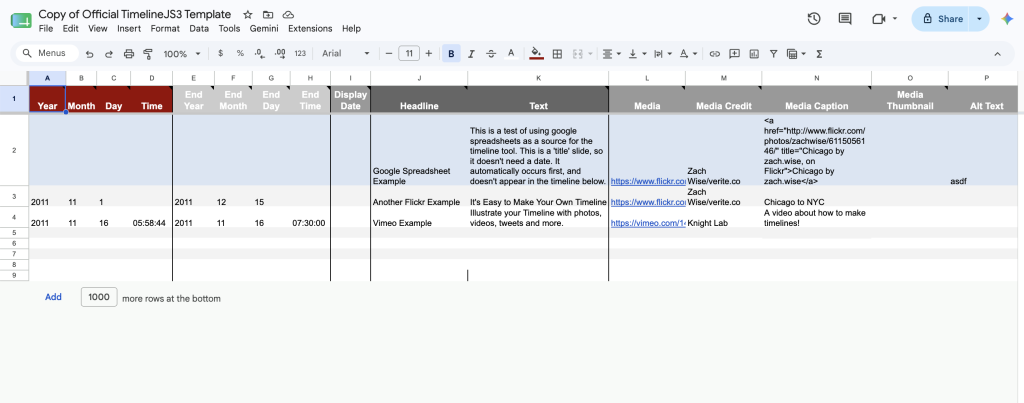
Figure 1 Column headers in TimelineJS template sheet
- Make a new Google Form that will be student-facing and will automatically populate a Google Sheet that will eventually generate the timeline. Go to https://docs.google.com/forms/ and create a new blank form. (You may also use our template if you do not mind using our category headings.) Each question on the Google Form will correspond to a header and populate its corresponding column in the Google Sheet. You will want to pose questions on the Google Form in the same order as the headers in the template, but you do not need to ask questions for all columns, and you can ask extra questions that do not exist in the template sheet (such as student name, email, etc.). It’s best to ask any extra questions either at the beginning or at the end of the form, rather than intersperse extra questions between those that are represented in the existing headers. N.B. Keep the questions that are meant to correspond to template column names in the same order as the headers of the template, even if some are omitted. (Figure 1 above shows the template headers. Figure 2 below shows examples of a Google Form template. If you compare these two images, you will see that “Name” appears in the form in figure 2 but not in the sheet in figure 1—this is okay!). Google Forms will automatically record timestamps of student responses. We also recommend asking the Google Form to automatically capture student emails in case students have similar names. Questions we use:
- Your Name
- Year (or starting year for a date range)
- End year (optional; leave blank for entries that are not for a date range, but for a single date)
- Title of your entry
- Description of entry
- Media (must be linked directly from the media source, not an uploaded image/video)
- N.B. The media link is important! We recommend demonstrating to students how to do this step (and how not to do it!) when introducing the assignment. When selecting an image from the internet, you must select “copy image address” or, for a video, use a YouTube/Vimeo link. Spotify does not work well on the timeline, and video thumbnails create better visuals. Mistakes at this juncture can result in an error message or blank space where the image is supposed to be. Fortunately, you can fix errors in the spreadsheet, but a thorough demonstration will likely save you time and students frustration. This process is also demonstrated in the accompanying video.
- Media caption (briefly describe the image or video)
- Media credit (e.g., “Wikimedia,” “Library of Congress”)
- Optional tag (e.g., person, historical event, musical piece). Tip: Make this a drop-down menu to limit choices and keep the timeline cleaner. This column will eventually align with “GROUP” in the template.
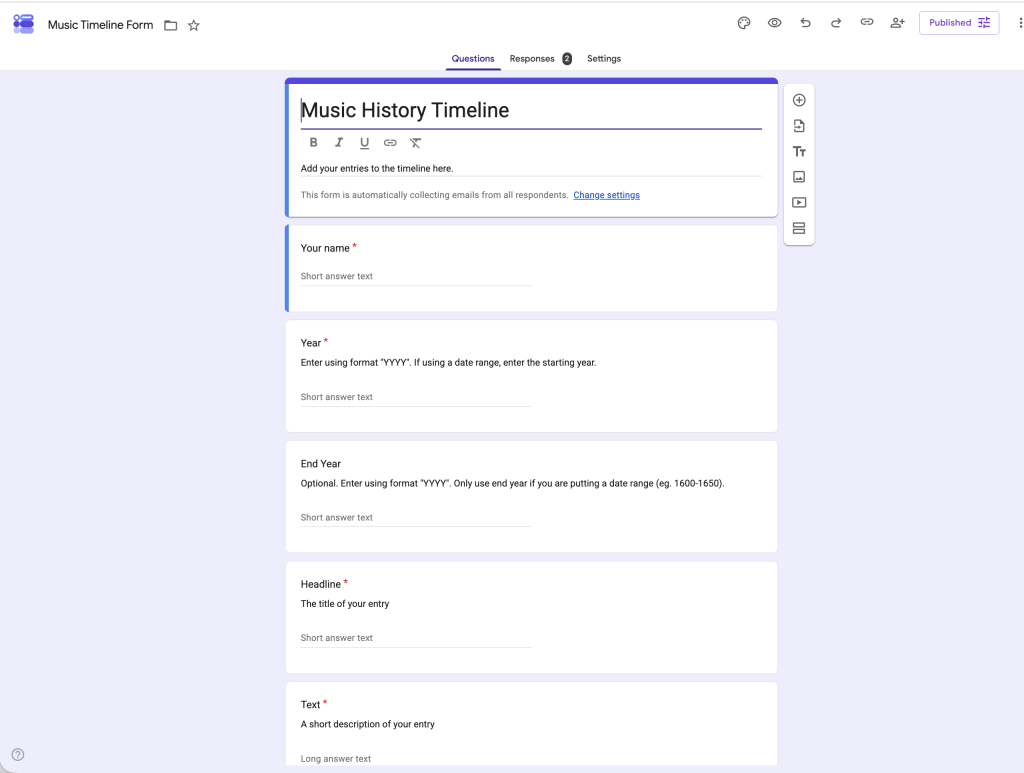
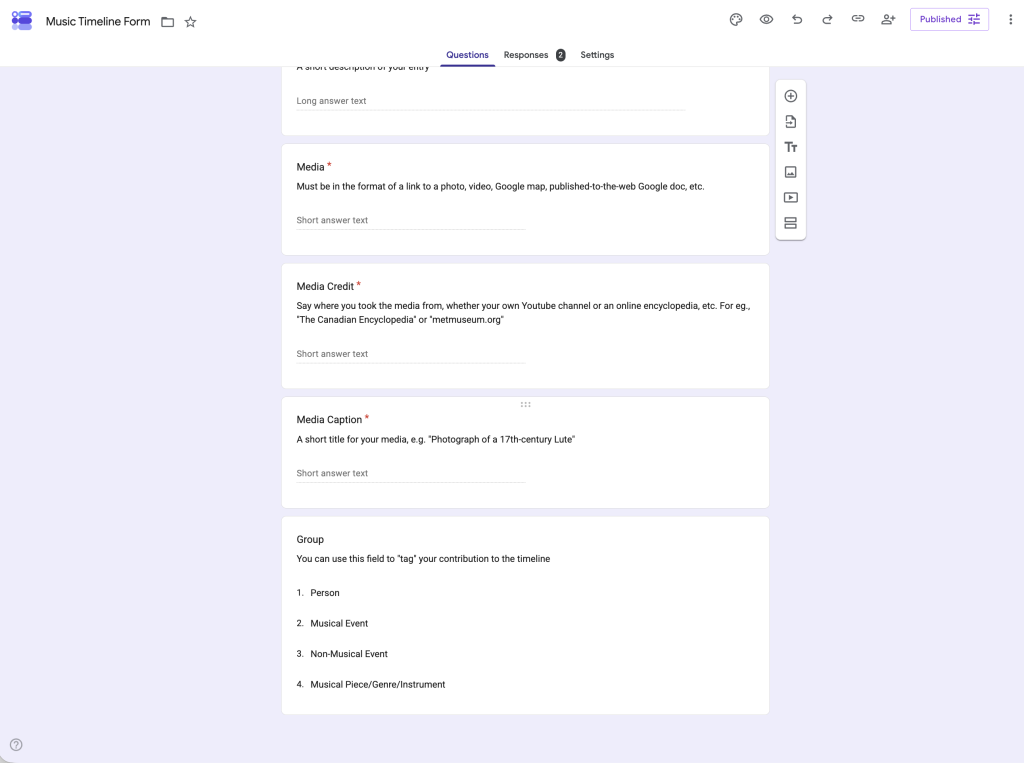
Figure 2 Example of Google Form backend
- Make Google Form responses editable and publish the form. When calibrating the settings of your Google Form before you share with students, we recommend making the Google Form responses “editable” so students can go back in and edit their response if, for example, they look at the timeline and notice that their media did not work correctly. Incorrectly linked media will not appear in the timeline and dates entered in the wrong format will “break” the timeline. You can fix these within the spreadsheet, but students may be able to achieve some fixes on their own through editing their responses. You should also publish your Google Form (click the “Publish” button at the top right of the page) so that it can collect form responses.
- Generate a new Google Sheet from your new Google Form. Navigate to the middle tab of your Google Form, “Responses,” and click “Link to Sheets” and then select “Create a New Spreadsheet” and name it whatever you like—we usually include the course code and year at minimum. N.B. You are not using the template downloaded from TimelineJS in the actual assignment; instead, you will use TimelineJS’s template to guide the formatting of your new Google Sheet.
Video 2
- Resolve the differences between columns of the newly generated Google Sheet with those of the template Google Sheet from TimelineJS. Essentially, the TimelineJS website will read your sheet and look for familiar headers. If any are missing, the timeline will “break.” You want your column headers to contain, in the exact same order, the same headers as in the template. New headers, such as the timestamp that is automatically generated by Google Forms and any other new pieces of information you gathered from your students through Google Form responses, such as their names, will not affect the timeline website; it will simply ignore these. Thus, you must add new columns to your newly generated Google Sheet so that every column from the template is represented there. Some of the columns from the template will already be represented, thanks to your questions in the Google Form that aligned with the template columns, such as Title or Year. You may type the new headers yourself but ensure they are identical to those in the template. Another option is to copy and paste (one at a time) the template column headers into the new columns in your own spreadsheet to ensure exact likeness. This is especially helpful in the column “type,” for which copying will allow you to capture the formatting used by TimelineJS and retain the option to create a title slide. Remember, you must first generate a sheet from the Google Form if you want students to be able to submit entries through the Google Form and have them immediately populate the timeline. N.B. The Google Form will read this newly generated sheet and it is not possible to simply copy and paste all headers from the TimelineJS template into existing columns on the sheet generated from the form; instead, you must add new columns where they are missing in the sheet generated from the form and copy and paste only the missing headers. We highly recommend watching the video tutorial for this step.
- Compare the generated Google Sheet to the template you downloaded.
- As you read the columns of your newly generated Google Sheet from left to right, add new columns where any are located in the template but missing in your generated spreadsheet. For example, the first four columns in the template read: Year (A), Month (B), Day (C), and Time (D). In the newly generated Google Sheet, your leftmost column, A, will be Timestamp, then potentially Your Name (B) and Email (C) before finally coming to a matching header, Year, in Column D. Perhaps you did not ask students to provide Month, Day, and Time, and so these three columns are missing. To resolve this difference, insert new columns where any are missing and add missing headers. Now, your resolved spreadsheet will have the following column headers: Timestamp (A), Name (B), Email (C), Year (D), Month (E), Day (F), Time (G). N.B. You cannot simply rename existing columns, because the Google Form retains that column identity; for example, whatever column is “Year” will always populate with the information from that question in the form. To reiterate, you must add new columns between the existing columns to create cells that will not be populated by the Google Form, but that can still be read by the TimelineJS software.
- Continue adding columns until you have the same number of columns (plus any additional ones you added in the Google Form, such as student emails) as the template. Ensure every column from the template is represented exactly in your new spreadsheet in the same order as the template. For your reference, we include the list of template column headers in the correct order here (those in bold are the ones represented in our Google Form example above and will therefore already be present in the new Google Sheet; all un-bolded items in this example would have to be added as new columns in the new Google Sheet):
- Year
- Month
- Day
- Time
- End Year
- End Month
- End Day
- End Time
- Display Date
- Headline
- Text
- Media
- Media Credit
- Media Caption
- Media Thumbnail
- Alt Text
- Type
- Group
- Background
- Make sure your column headings match the template. Yes, double check; this is the stage where you are most likely to have issues. You may wish to try populating your spreadsheet with a test answer in the form so you can see where the information goes in the new spreadsheet. Knight Lab software reads these column headers to generate your timeline, so it is critical that the column headers in your newly generated sheet align with the template, and that the Google Form answers fall under the correct columns. If you do a test answer, you will be able to see if the columns you added in the previous step are in the correct positions. See figure 3 below for an example of the new sheet with all column headers from both the original template sheet and the form responses.
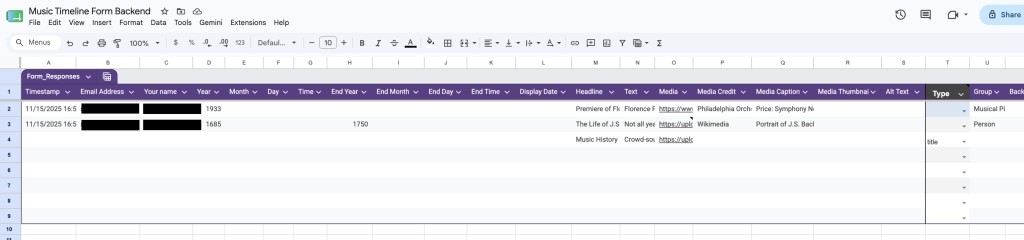
Figure 3 Example of sheet with columns from template and form
Video 3
- Make a title slide to introduce the timeline. This slide will be the landing page of the timeline; if you do not include one, the earliest chronological entry will serve as the landing page. To make a title slide, do not use the Google Form but go straight into the newly generated Google Sheet to add your own entry. Under the column “Type,” choose “Title.” Do not add a date for this entry. You may wish to include a relevant image and the title of the class, with a brief description of the timeline.
- Publish your Google Sheet. (This is part of the Knight Lab TimelineJS instructions but an easy step to forget). Make sure you publish the new sheet before generating your timeline, which you will do on the Knight Lab page (see step 10). Go to File → Share → Publish to Web → click “Publish” in the pop-up window (leave settings at “Entire Document”). Copy the link that appears in the “Publish to Web” pop-up box.
- Generate your timeline. Paste the URL of your published Google Sheet into the box in step 3 of the instructions on the Knight Lab page to finally generate your timeline. Follow their link to see your new timeline! At this point you may have to troubleshoot columns that may not be in the right order. If this is the case, go back and look carefully at your new sheet and compare it to the template sheet downloaded from Knight Lab.
- Demonstrate for your class. We highly recommend demonstrating for your class how to add an entry and troubleshooting some common mistakes such as typing the date in the wrong format or providing an incorrect media link. This should avoid most issues that would arise in the early weeks of using the timeline and save you some precious time!
APPENDIX 2: SAMPLE ASSIGNMENT HANDOUT
Timeline Assignment
In this class, you are all music historians. Each of you will contribute to the historical narrative in our class by posting an entry to the course timeline each week for ten weeks (no posts required on weeks with tests). I encourage you to think outside the box and challenge yourself to find new-to-you music, people, artifacts, sites, and spaces and think carefully about your entry’s role in history. This is your chance to pursue your own interests. Our timeline will be a shared class resource. We will regularly take time in class to look at the latest updates; come prepared to speak about what you added and why.
Entries can include events, objects (instruments, etc.), musical pieces, people, genres, etc. A maximum of 50% (half) of your entries may be taken from lecture material, the rest you should explore on your own. You may also choose not to use any entries from lectures.
A final important rule: Do not add an entry that already exists. For example, if someone has already added the date of the invention of the printing press, no one else can post about that specific event. You can, however, make an entry about a different facet of an existing entry: for example, the first printed piece of music.
Reviews are due on select Thursdays at 10:00 p.m. ET [specific dates listed below in original] and will be discussed in the following class.
Each entry will be worth 2% of your final grade and they will be graded on completion, with 1% awarded for each of the two parts. Your willingness to discuss and present your timeline in class will contribute to your participation grade.
Each timeline contribution consists of two parts:
- A post, using the provided Google Form to generate our timeline. Details below:
- Name: Record your name as author of the entry.
- Year: Add a year (YYYY) (choose entries from 1600–1800 or slightly outside if justifiable).
- End Year: If adding a time range, add an end year (YYYY).
- Headline: Create a headline/title for your event.
- Text: Write a one- to two-sentence description of the event.
- Media: Add a link to an image (needs to be a picture-only link), video, Google Map coordinate, or whatever you think will best represent your entry—feel free to be creative. Double check once you submit the form that your media has shown up correctly. If it hasn’t, you should be able to edit your response. If that doesn’t work, contact me for troubleshooting.
- Media Credit: Cite the source of your media.
- Media Caption: Caption the image.
- Group: Use this drop-down menu to choose a “tag” to organize your entry. If it doesn’t fit in any of these categories, email me to propose a new category or leave it blank.
- A two-paragraph reflection on your contribution in the discussion board on [course website]. Please cite your sources using the latest Chicago Manual of Style.
Paragraph 1
Describe the event/object/piece and its historical context. Set the scene for your reader, considering, as relevant:
- When and where did this event take place?
- Who was involved?
- What happened before, during, and after this event?
- Details of premiere (for piece), usage (for instrument/genre/venue).
- If a piece of music, include some description of musical elements.
Paragraph 2
Reflect on what this entry contributes to our understanding of the history of music in this time period. This is an argument for its inclusion in the timeline. Consider:
- How does this entry relate to other historical phenomena discussed in our course or in other timeline posts?
- Does this event challenge your ideas about music? How?
- How does this entry help you understand music from this historical era?
- How does this entry relate to other fields of inquiry/practice? (E.g., music theory, composition, performance, concert programming, classes you’ve taken in other fields, etc.)
- How would our understanding of music history be different without this entry?
- We use the term collaborative here to mean that students collaborate to create a single final product, the timeline, or even a history of music. Each student creates their contributions individually, but the resulting product is a crowdsourced history of music. Despite working alone, students learn from each other when sharing their entries in class.↗
- Alejandro L. Madrid, “Diversity, Tokenism, Non-Canonical Musics, and the Crisis of the Humanities in US Academia,” this Journal 7, no. 2 (2017): 125. See Margaret E. Walker, “Towards a Decolonized Music History Curriculum,” this Journal 10, no. 1 (2020): 5; and Marianna Ritchey, “A Critical Perspective on Diversity and Inclusion in US Classical Music Discourse,” in Voices for Change in the Classical Music Profession, edited by Anna Bull and Christina Scharff (Oxford University Press, 2023), 94–99.↗
- Walker, “Decolonized Music History Curriculum,” 1–2.↗
- David Salkowski, “Toward a People’s History of Western Music,” this Journal 15, no. 1 (2025): 1.↗
- Ritchey, “Critical Perspective,” 91, 96–97. The term powerblindness is theorized by Barbara Tomlinson in Undermining Intersectionality: The Perils of Powerblind Feminism (Temple University Press, 2018).↗
- Olúfẹ́mi O. Táíwò, Elite Capture: How the Powerful Took Over Identity Politics (And Everything Else) (Haymarket Books, 2022). See also Loren Kajikawa, “What Does Race Have to Do with Music Libraries and the Performing Arts?” Notes 78, no. 3 (2022); and Ritchey, “Critical Perspective,” 94–99.↗
- Salkowski, “Toward a People’s History.” See also Douglass Seaton, “Reconsidering Undergraduate Music History: Some Introductory Thoughts,” this Journal 5, no. 2 (2015): 53.↗
- Melanie Lowe, “Rethinking the Undergraduate Music History Sequence in the Information Age,” this Journal 5, no. 2 (2015).↗
- The term signature pedagogies comes from Lee S. Shulman, “Signature Pedagogies in the Professions,” Daedalus 134, no. 3 (2005); Lee S. Shulman, “Pedagogies of Uncertainty,” Liberal Learning 91, no. 2 (2005); and Lendol Calder, “Uncoverage: Toward a Signature Pedagogy for the History Survey,” Journal of American History 92, no. 4 (2006).↗
- As Matthew Baumer has noted, a 2011 survey evaluating 101 programs and conducted for the National Association of Schools of Music showed that 90 percent of departments use a two-, three-, or four-semester chronological survey, with only a small percentage (one in ten) adopting an alternative structure. Baumer, “A Snapshot of Music History Teaching to Undergraduate Music Majors, 2011–2012: Curricula, Methods, Assessment, and Objectives,” this Journal 5, no. 2 (2015): 25–26.↗
- Paulo Freire, Pedagogy of the Oppressed (Herder and Herder, 1970), 35.↗
- Indeed, reform of music history curricula could be seen as a bandage for the larger problems of laboring within a capitalist framework. Within the neoliberal classroom, students can benefit from engaging critically with the way rhetorics of “do it yourself” and “do what you love” shape the careers of an ever-growing body of “failing” students. See Marianna Ritchey, Composing Capital: Classical Music in the Neoliberal Era (University of Chicago Press, 2019), 88; Miki Kaneda, “Do What You Love? New Music, New Work—After 2020,” Journal of Musicology 40, no. 2 (2023): 161–67; and John Pippen, “Success and Music Education: Teaching the Value of Art in the Neoliberal University,” in Teaching Difficult Topics: Reflections from the Undergraduate Music Classroom, ed. Olivia R. Lucas and Laura Moore Pruett (University of Michigan Press, 2024), 16–17, 23.↗
- TimelineJS, Knight Lab, Northwestern University, accessed August 9, 2026, https://timeline.knightlab.com/. Other timeline software exist, although we have not tried them. The reasons for not trying these alternatives include the fact that some are proprietary or paid, and others seemed less user-friendly, although of course that is subjective. Some examples include: The Timeline Project (open source), SourceForge, accessed August 9, 2026, https://sourceforge.net/projects/thetimelineproj/; Aeon Timeline (paid software), accessed August 9, 2026, https://www.aeontimeline.com/; ChronoFlo Timeline Maker, Webalon, accessed August 9, 2026, https://www.chronoflotimeline.com/; and Tiki-Toki Timeline Maker, Webalon, accessed August 9, 2026, https://www.tiki-toki.com/.↗
- On working with librarians in music classrooms to strengthen students’ information literacy, see Sara J. Beutter Manus, “Embedding the Framework: Using Embedded Librarian Techniques to Facilitate Music Information Literacy,” in Ideas, Strategies, and Scenarios in Music Information Literacy, ed. Kathleen A. Abromeit (Music Library Association and A-R Editions, 2018). Beyond scheduling visits from music or general librarians to support students’ use of library resources, some useful tools include: Oxford Music Online’s organizational tabs (found on the home page in a menu along the top, including “Instrument,” “Era,” “Region,” “Place Type,” and “Occupation,” and their “Timelines” found under “Tools and Resources” → “Subject Guides and Research Sources” → “Timelines”), accessed August 9, 2026, https://www.oxfordmusiconline.com; museum collection websites, such as the Metropolitan Museum of Art’s collection of musical instruments (“Musical Instruments,” Metropolitan Museum of Art, accessed August 9, 2026, https://www.metmuseum.org/departments/musical-instruments) or the Bate Collection at the University of Oxford (“The Bate Collection,” University of Oxford, accessed August 9, 2026, https://www.bate.ox.ac.uk/collection); and RILM Abstracts of Music Literature (RILM, accessed August 9, 2026, https://www.rilm.org/abstracts/); among others.↗
- Student evaluations, “History of Western Music IV,” MUSIC-284-01, Mount Holyoke College, spring semester 2024.↗
- Student evaluations, “History of Western Music IV,” MUSIC-284-01, Mount Holyoke College, spring semester 2024.↗
- Student evaluations, “History of Western Music IV,” MUSIC-284-01, Mount Holyoke College, spring semester 2024.↗
- This course took place at Brandeis University in the spring semester of 2023 and met twice a week for eighty minutes. Koval chose not to use a textbook but organized the course chronologically and included many pieces that appear in the first two volumes of Claude V. Palisca, Donald Jay Grout, and J. Peter Burkholder, Norton Anthology of Western Music, 8th ed. (W. W. Norton & Company, 2019). Here is its resulting timeline.↗
- This class took place at Mount Holyoke College. Here is the timeline for this class.↗
- Since our initial uses of the timeline described here, we have used the timeline in more classes and in multiple institutions. We believe this assignment might be adapted to a larger class by reducing the number of entries required or creating multiple timelines and dividing up the class into groups.↗
- These “interventions” were inspired by Adeline Mueller’s music history sequence syllabus that contained an assignment called “Canonical Intervention Presentations,” which she kindly shared with Comuzzo when they joined the Mount Holyoke College faculty as visiting instructor.↗
- Student evaluations, “History of Western Music IV,” MUSIC-284-01, Mount Holyoke College, spring semester 2024.↗