
In a watershed essay on the difference between music analysis and musical hermeneutics, Kofi Agawu expounds the difficulty we face in treating music as a text. To get at and convey the meaning of a work, he argues, the discourse of music theory has convened an array of what we might call “straw listeners” around the musical score—“the naive listener, the educated listener, the trained listener, the ordinary listener, the competent listener, even the ideal listener.”1 The notion that “listening” is a construct is, of course, neither new nor necessary to be rehearsed here. (And, as Agawu rightly notes, for the analyst, such a multiplication of hypothetical listeners has often served to evade the responsibility of developing “ethnographically secure characterizations” of listener behavior.2) But it bears repeating that the pursuit of music’s meaning—or, at the very least, the desire to instill in students a slate of skills that might approach the same—is a path beset by pitfalls and laden with assumptions.
In North American universities, undergraduate music theory courses tend to presume an ideal mode of listening.3 Consider that the teaching of harmonic function and modulation often rehearses a student’s development from a state of untutored “naivete,” to one of “competency,” to one of “expertise.” Students practice distinguishing between notated tonic and dominant chords, after which they learn about prolongation and expansion of these elements.4 Likely, instructors use language that assumes a student’s transition from recognition to intuition: “We hear G major as the new tonic here,” or “We remember this modulation from the exposition section,” and ultimately, “We expect a resolution.” In this moment, the instructor’s presumption of ideal listening is an assumption of teleological listening. In other words, students are time and again asked to measure phrase lengths, attend to harmonic resolutions, and make motivic connections across large spans of time. This, in turn, supposedly enables analysis, which conveys meaning and yields insight.
As an instructor of undergraduate music theory, I have had numerous opportunities to recalibrate such presumptions and assumptions about students’ listening experiences. Inspired by students on the autism spectrum and with symptoms of attention-deficit/hyperactivity disorder (ADHD), I have observed that modeling a singular, ideal type of teleological listening forecloses other rich pathways into music analysis.5 Such modeling can be detrimental to individual student success and class morale. Applying the principles of Universal Design for Learning, or UDL, in undergraduate music theory classes can make listening for analysis more rewarding.
Simply put, UDL means optimizing learning for everyone, regardless of background or ability.6 One of UDL’s key principles is “multiple means”—of engagement, representation, and of action and expression. In what follows, I consider how a learner-centered music theory classroom guided by the principles of UDL becomes a wonderful space in which to celebrate the multiple perspectives of our students. I focus on a particular context: the fourth semester of the core music theory sequence at my home institution, the University of Wisconsin–Madison, which covers compositional and stylistic innovations of the twentieth and twenty-first centuries. Next, I present three lessons for analysis I designed to engage students from varied musical backgrounds and with differing skill sets in “analysis,” generally speaking. They are centered on three pieces, treated as case studies below: Julia Perry’s Homunculus C.F. (1960), Anthony Braxton’s “To Composer John Cage” (1971), and Philip Glass’s Einstein on the Beach (1976). Last, drawing on deconstructionist thought, I discuss how undergraduate music theory might benefit from its manifold listeners and the creative analytical techniques they devise.7
Setting the Scene
The Mead Witter School of Music at the University of Wisconsin–Madison is home to bachelor of arts, bachelor of music, and bachelor of science degrees in performance, music education, composition, and jazz studies. The bachelor of music in performance degree requires approximately ninety credits of coursework in music, sixteen of which are devoted to a four-semester music theory sequence. All four semesters of music theory feature fifty-minute, faculty-led “lectures” that meet twice weekly, along with two additional discussion and aural-skills sections, which are led by graduate student teaching assistants. Since 2022, enrollment in the fourth semester of music theory has ranged from sixteen to twenty-seven students in any given year.
The fourth semester of theory focuses on music we categorize loosely as “post-tonal.” The goals for this semester include learning and practicing conventional post-tonal analytical techniques. Students in this course also practice describing musical phenomena in spoken and written prose. For many students, post-tonal music can be liberating. I’ve heard from several students that integer notation makes logical sense to them. For some, however, the shift from music they know, have performed, and (in many cases) enjoy to the unfamiliar sound worlds of contemporary music can be jarring. It is thus essential that instructors acknowledge the many barriers to entry—aesthetic and cultural—post-tonal music presents. For these and other reasons, post-tonal music theory pedagogy presents an especially fruitful area for the application of UDL principles. Too often, the post-tonal music theory classroom becomes a space for hunting sets and identifying rows. Without disregarding the utility of these activities, what if we as music theory instructors took post-tonal music as an opportunity to make the classroom a more dynamic and welcoming space?
Case Study 1: Julia Perry, Homunculus C.F. (1960)
As recent critical interventions have shown, the repertoire used in core undergraduate music theory courses overwhelmingly centers white, male composers.8 This is especially true for twentieth-century music and its compositional techniques, which skew toward the contributions of a very small group of modernists (i.e., the early atonal works of Arnold Schoenberg and the Second Viennese School). The analysis of this music concerns pitch content: the application of integers, the imbrication of sets, the identification of row forms and their permutations, and the elaboration of the connections among the musical ideas.
Looking to incorporate more underrepresented composers and repertoire in the classroom, I discovered Julia Perry’s work for percussion ensemble from 1960, Homunculus C.F. The work is ideal for beginning students of post-tonal music. For one, it is for a medium-sized ensemble, not unlike the more canonical Pierrot lunaire, which I also teach, and offers exciting opportunities to practice score reading. (This is especially engaging for orchestral musicians and music educators, as so many music theory examples are written or transcribed for piano.) For another, the structure of Perry’s Homunculus is crystal clear. Formal analysis in the classroom can be time-consuming; identifying sections of post-tonal music can be discouraging for some students, especially in light of how tonal music theory trains students to listen for recurring or recapitulating themes or motifs. Among other things, Perry’s work is an elaboration of a single harmony, which she labels the “chord of the fifteenth,” i.e., “C.F.” (example 1). With the pitch content delimited as such, Homunculus invites students to focus on the relationship between rhythm and form, a welcome shift in perspective after several weeks of intense focus on new harmonies and contrapuntal techniques.9
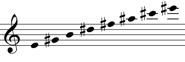
Example 1 Julia Perry, Homunculus C.F. (1960), chord of the fifteenth
I use a worksheet that includes biographical information, pictures, discussion questions, activities (including transcriptions and tables to populate), and a summative reflection question to guide our fifty-minute lesson on Homunculus. We begin by reading about Perry, discussing what a homunculus is, and reading the associated passage from Goethe’s Faust. Next, we break into four groups of four to six students. Each group is assigned to one of the piece’s four formal sections. In these groups, the students populate a variety of tables with descriptive terminology, building on several semesters of describing melodic contour, harmonic consonance or dissonance, rhythmic patterning and metrical isochrony, formal groups, and affect to develop a shared musical vocabulary for discussion. After a brief check-in with the full class, the students return to their groups and copy out two eight-measure phrases from the full score, both from the snare drum part, and compare them. Often, the groups work collaboratively on this exercise, although some students choose to work individually. Finally, they are asked to briefly (ca. five minutes) summarize and discuss their findings and, individually, write a paragraph answering the following question: Referring to Goethe’s Faust, what musical devices does Perry use to depict the formation of the homunculus? The instructor monitors the time and travels between groups to answer questions and help maintain focus.
These activities and discussion enact core principles of Universal Design, which emphasize multiple means of engagement, representation, action, and expression. Students work collaboratively in groups, individually, and as a full class and are empowered to navigate between these various learning modalities as they choose. The scaffolding of the lesson plan assists students in shuttling between micro and macro features of the music and with placing the piece in cultural context. The tasks are varied and there are several ways in which students might express themselves: verbally within the group, to the class, to the instructor, and in written prose. All of this promotes both individual and collective reflection and, crucially, affords students the opportunity to model empathy to one another.10
Case Study 2: Anthony Braxton, “To Composer John Cage” (1971)
Composed in 1960, and with its clearly articulated form and emphasis on rhythm, Perry’s Homunculus helps students transition from a modernist to a postmodernist sound world. In a vein similar to the exploration of postmodernism, analyzing improvisation presents a host of new challenges for students and teachers alike. Often for the sake of convenience, instructors avoid having to contend with music that is not or cannot easily be transcribed using conventional notation. (In many music theory classrooms, the score becomes the lesson’s guiding object, often at the expense of listening and transcription.) More problematically, as George E. Lewis has demonstrated, the discussion of improvisation in so-called “art music,” such as in the aleatoric works of John Cage or in early minimalism, often fails to redress this repertoire’s appropriation of elements from jazz and vernacular musics, as well as non-Western philosophies.11 Similarly, timbre and texture are too often considered “secondary parameters” compared to pitch, rhythm, and form. As a result, some musical traditions—particularly those with roots in Black American aesthetics—may not be fully reflected in the curriculum.
Anthony Braxton’s improvisation for solo alto saxophone, “To Composer John Cage,” makes for a stimulating introduction to improvisation as a technique as well as to the experimental art movements of the 1960s and ’70s. Using an array of techniques such as multiphonics and overblowing, Braxton explores the vast world of the saxophone’s sonic affordances. More critically, the piece actualizes Braxton’s own philosophy of creative expression through extended, expanded, and alternative sounds.12 The learning outcomes for this activity include considering philosophical questions about the difference between composition and improvisation, how we might use recorded music as musical examples to support analysis, and how graphics can convey the meaning of un-notated music.
In preparation for class, the students listen to the entire ten-minute piece on their own. A recording is provided on Canvas LMS, and the students can stream it on their devices in an environment of their choosing. They are asked to identify and write down time stamps where they hear the music animate a specific musical parameter: melody, contour, meter/rhythm, register, and timbre/texture. In class, the students are divided into five groups, each of which is assigned a thirty-second excerpt. I encourage the students to go off on their own individually and listen to the excerpt at least five times. They may choose to take notes about their excerpt, in written form or as annotations to the recording. Reconvening in their small groups, they are tasked with developing a diagram that illustrates the excerpt for a nonspecialist who is unfamiliar with the piece. I provide X–Y axes and a blank page, and they can use tablets, phones, and colored pencils—whatever they have at their disposal. We wrap up class by sharing a few diagrams and discussing whether a visual representation of the music can aid in drawing insights from it.
As with Perry’s Homunculus, Braxton’s piece engages students in both individual close listening and collective analysis generated through full-class and small-group discussions. The use of multiple media and means of representation is key here. Student choice and autonomy regarding environment and creative work emphasizes accessibility and approachability. Finally, short clips invite repeated listening, which helps to fortify memory, focus student attention, and encourage students to immerse themselves meaningfully in Braxton’s work.
Case Study 3: Philip Glass, Einstein on the Beach (1976)
Despite its prevalence in film, video games, and popular music, minimalism can be difficult for undergraduates to analyze. Some have indicated to me that they “zone out” when listening to this music. This is hardly surprising: Having practiced teleological listening for several semesters, when they are newly confronted by music that can intentionally undermine the logic of expectation, students struggle to give this repertoire their full attention. This is especially true for those with symptoms or diagnoses of attention-deficit/hyperactivity disorder (ADHD), but not exclusively.13 A major goal for the lesson on Einstein on the Beach is to introduce students to some tools to analyze music that does not easily conform to conventional time scales or formal development. Such an analysis benefits from the principles of UDL. Incorporating visuals and a kinesthetic medium like dance, however, provides a helpful framework for students’ engagement.
Guided by several questions posted on Canvas, the students prepare for Einstein on the Beach by visually examining the score for “Knee 1,” which immediately follows the Prologue. They also read selections from the libretto and watch two medium-length clips from the 2014 Théâtre du Châtelet production: “Knee Play 1” and “Dance 2.”14 In class, we read aloud selections from Timothy A. Johnson’s 1994 article, “Minimalism: Aesthetic, Style, or Technique?” In groups of three to four people, students are tasked with populating a worksheet describing how the opera falls into Johnson’s three titular categories. Reconvening as a class, we make a list of the minimalist techniques Glass employs, focusing on the composer’s “general reduction of materials and emphasis on repetitive schemes and stasis.”15 Typically, the students signal the use of only three harmonies, the repetitive use of numbers in the libretto, and the preponderance of repeat signs as examples of such techniques.
“Dance 2” dramatizes the tension between subdivisions of the beat into groups of two and three. Asking students to count groups of measures will only breed frustration: Some will attune to the solo violin, some the bass, others the choir. The effect can be dizzying, especially when hypermetrical groups of four and six phase in and out of sync. When the students watch Lucinda Childs’s choreography for this movement, they quickly tap into two kinesthetic gestures—“bounce” and “circle” (see figures 1a and 1b).

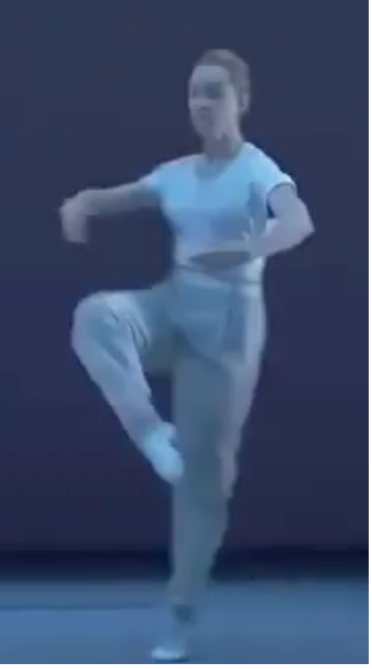
Figures 1a and 1b “Bounce” (left) and “circle” (right) from Philip Glass, Einstein on the Beach, “Dance 2”
We experiment with tracking only one of these gestures at a time, exploring how it connects with and pulls apart from the ostinatos in groups of two and three. We attempt to “circle” during the bounce sections and vice versa. Using our bodies, we discover that, by tapping into the dance’s multiple time scales, we can experience the processual effect of the music firsthand, yielding insights about form and structure.
Conclusion
How can imagining multiple means of engagement with course material make the music theory classroom more rewarding for everyone? Featuring a multiplicity of genres and styles, music from the twentieth and twenty-first centuries is rife with opportunities to implement a UDL-minded, student-centered approach to analysis. As the foregoing examples illustrate, retooling how we define post-tonal theory—and the skills we want students to explore when approaching this repertoire—does not supplant the teaching of valuable skills such as reading musical scores. Instead, it suggests that with support from the instructor and added resources, students can gain a deeper understanding of what music analysis can offer. More importantly, keeping the ideals of relevance, representation, and authenticity at the fore of our teaching is another way UDL nuances our notion of what listening in the music theory classroom really entails.
Ultimately, I’d like to invite us to use UDL to trouble the notion of an “ideal” listener, which has been a central premise of deconstructionist thinking about music analysis since the mid-1990s. As Rose Rosengard Subotnik expertly demonstrates, for undergraduate music theory, ideal listeners are often construed as “structural” listeners.16 Pursuing music’s “epistemological transparency,” this mode privileges musical structure as self-contained and autonomous, effectively reducing our variegated, rich experiences of sonic events down to music’s text: the score.17 But as Patrick McCreless has argued, music theory’s pedagogical imperative—that instructors explain and interpret musical works, represented by scores, and model analytical inquisitiveness—impels us to consider a middle path that imparts skills and techniques but does not privilege a singular “ideal” positionality.18 (And indeed, how could it, since such a positionality is entirely illusory?) More recent interventions by those working at the intersection of music theory and disability studies, including Joseph N. Straus, Andrew Dell’Antonio, Dylan Robinson, and Byrd McDaniel have amplified the urgency of dispelling the myth of ideal or “normal” listening.19 Inspired by UDL’s premise of “multiple means,” I hope to have illustrated how implementing some small changes—from repertoire choice, to the presentation of ideas, to creating a variety of opportunities for student engagement—can empower students to listen to music in ways that are meaningful to them.
- Kofi Agawu, “Music Analysis Versus Musical Hermeneutics,” American Journal of Semiotics 13, nos. 1–4 (1996): 10, https://doi.org/10.5840/ajs1996131/42. The term straw listener is mine and I use it in the same sense as the expression “straw man,” which the Oxford English Dictionary defines as “an intentionally weak or misrepresented proposition.” Oxford English Dictionary, “straw man (n.),” December 2024, https://doi.org/10.1093/OED/1093738988.↗
- Agawu, “Music Analysis,” 10.↗
- For an epistemology of listening versus hearing for analysis, there is historical precedent in European Enlightenment philosophy. On this, see the introduction to Byrd McDaniel, Spectacular Listening: Music and Disability in the Digital Age (Oxford University Press, 2024); as well as Jairo Moreno, Musical Representations, Subjects, and Objects: The Construction of Musical Thought in Zarlino, Descartes, Rameau, and Weber (Indiana University Press, 2004). In 1818, the music critic and theorist Gottfried Weber dubbed his ideal listener “das Gehör,” that is, “the ear,” or “hearer,” a neologism that the academy has retained. See Gottfried Weber, Versuch einer geordneten Theorie der Tonsetzkunst, vol. 2 (B. Schott’s Söhne, 1818). On the passage in Weber specifically, see Janna K. Saslaw, “Gottfried Weber and the Concept of Mehrdeutigkeit” (PhD diss., Columbia University, 1992), 193.↗
- On harmonic prolongation, especially as reproduced for the North American academy, see Felix Salzer, Structural Hearing: Tonal Coherence in Music, 2 vols. (Dover, 1962).↗
- The most current definitions for autism spectrum disorder (ASD) and attention-deficit/hyperactivity disorder (ADHD), including diagnostic criteria, are found in the fifth edition of the Diagnostic and Statistical Manual of Mental Disorders (DSM), published in 2013 by the American Psychiatric Association (APA), available at https://doi.org/10.1176/appi.books.9780890425596. On the intersection of autism and music, especially in the twentieth century, see Joseph N. Straus, “Autism as Culture,” in The Disability Studies Reader, ed. Lennard J. Davis (Routledge, 2013). For a recent study on therapeutic applications of music instruction for people with ADHD, see Sivan Raz, “Enhancing Cognitive Abilities in Young Adults with ADHD Through Instrumental Music Training: A Comparative Analysis of Musicians and Non-Musicians,” Psychological Research 89, no. 1 (2024): 9, https://doi.org/10.1007/s00426-024-02048-2.↗
- Universal Design for Learning was developed over several decades by the Center for Applied Special Technology (CAST). Its framework, which emphasizes curricular flexibility in engagement, representation, action, and expression, has been recognized internationally since the mid-2000s. See https://www.cast.org/what-we-do/universal-design-for-learning/.↗
- Developed by Jacques Derrida, the technique of “deconstruction” consists in the interrogation of assumptions encapsulated by language. It rejects the notion of unilateral or monolithic meaning and, in Rose Rosengard Subotnik’s words, the “hierarchical opposition between structure and medium.” Subotnik, “Toward a Deconstruction of Structural Listening: A Critique of Schoenberg, Adorno, and Stravinsky,” in Deconstructive Variations: Music and Reason in Western Society (University of Minnesota Press, 1996), 149.↗
- See Philip Ewell, On Music Theory, and Making Music More Welcoming for Everyone (University of Michigan Press, 2023), 38ff.↗
- Kendra Preston Leonard’s chapter on Perry’s Homunculus from Expanding the Canon is an indispensable resource. See “Teaching Julia Perry’s Homunculus C.F.,” in Expanding the Canon: Black Composers in the Music Theory Classroom, ed. Melissa Hoag (Routledge, 2022).↗
- Working collectively toward a goal fosters feelings of recognition and shared responsibility.↗
- George E. Lewis, “Improvised Music After 1950: Afrological and Eurological Perspectives,” Black Music Research Journal 16, no. 1 (1996): 91–122, https://doi.org/10.2307/1519950.↗
- See Anthony Braxton, Tri-Axium Writings, 3 vols. (Synthesis Music, 1985).↗
- UDL guidelines are not accommodations; all students can benefit from the framework. As many students experience symptoms of ADHD but do not have formal diagnoses, this fact is especially beneficial. My thanks to Gabrielle Cornish for bringing this crucial insight to my attention.↗
- Philip Glass and Robert Wilson, Einstein on the Beach, directed for television by Don Kent, conducted by Michael Riesman, performed by the Philip Glass Ensemble, featuring Helga Davis, Kate Moran, and Antoine Silverman, recorded at Théâtre du Châtelet, Paris, January 7, 2014 (Opus Arte, 2016), DVD.↗
- Glenn Watkins, quoted in Timothy A. Johnson, “Minimalism: Aesthetic, Style, or Technique?” Musical Quarterly 78, no. 4 (1994): 750, https://doi.org/10.1093/MQ%2F78.4.742.↗
- Subotnik, “Toward a Deconstruction,” 150.↗
- Subotnik, 157.↗
- Patrick McCreless, “Rethinking Contemporary Music Theory,” in Keeping Score: Music, Disciplinarity, Culture, ed. David Schwarz et al. (University Press of Virginia, 1997).↗
- McDaniel, Spectacular Listening, 9. See also Andrew Dell’Antonio, ed., Beyond Structural Listening? Postmodern Modes of Hearing (University of California Press, 2004); Dylan Robinson, Hungry Listening: Resonant Theory for Indigenous Sound Studies (University of Minnesota Press, 2020); and Joseph N. Straus, Extraordinary Measures: Disability in Music (Oxford University Press, 2011).↗