
Despite the centuries that have passed since its premiere in 1786 at the Burgtheater in Vienna, W. A. Mozart and Lorenzo da Ponte’s opera buffa Le nozze di Figaro remains one of the greatest and most influential operas ever written, its success owing in part to the productive expansion of Italian comic opera (opera buffa) during the preceding decades. Over the course of the eighteenth century, opera buffa rose in importance, serving as a vessel through which composers, librettists, and playwrights could convey social and class critiques, often through satire. In Le nozze di Figaro, the conventional opera buffa structure is employed and expanded, illustrating the changing values of eighteenth-century music and society while at the same time promoting an understanding of humanity that is not constrained by existing class structures. I argue here that Le nozze di Figaro is undergirded by established social tensions and structures that are cleverly satirized, reversed, and even critiqued through Mozart’s music, Da Ponte’s libretto, and Beaumarchais’s original narrative. This essay explores how the opera’s story, libretto, and music work together to challenge the societal structures and restrictions of its time, while simultaneously avoiding the risk of censorship.
Opera Buffa in the Eighteenth Century
Opera buffa has been described by Tim Carter as “a true product of the Age of Enlightenment.”1 It emerged as a counterpart to the exalted genre of Italian serious opera (opera seria) in the middle third of the eighteenth century.2 While opera seria typically focused on noble and heroic characters drawn from mythology and ancient texts, opera buffa focuses on contemporary events and the lives of ordinary people, often incorporating a satirical tone and social commentary. Opera buffa productions were originally much shorter in duration than opera seria, and customarily consisted of a smaller, more intimate cast. They were performed in between the acts of a serious opera and were therefore sometimes called “intermezzos.” For instance, the most famous early Neapolitan opera buffa, Pergolesi’s La serva padrona (1733), had a cast of three characters and lasted only forty minutes. Every element of the opera—especially the music—is carefully exaggerated.3 These opera buffa conventions are evident in Le nozze di Figaro, which features eleven named characters and a musical score that highlights and exaggerates the satirical elements, particularly its social critiques. Mary Hunter argues that opera buffa earned its comedic reputation through its constant stretching of the boundaries of various conservative elements within eighteenth-century society.4
While early comic operas typically portrayed stock characters drawn from the commedia dell’arte, the later eighteenth century saw the emergence of more complex characters.5 In the early 1760s, opera buffa was heavily influenced by Carlo Goldoni, a revolutionary and prolific Venetian playwright. Goldoni changed the course of Italian theater, expanding upon commedia dell’arte plots and archetypes by introducing realistic characters drawn from all levels of society, and building his dramas around spontaneous and compelling action. Piero Weiss observes that Goldoni’s comic-opera dramaturgy can be characterized as an integration of “spoken tragicomedies and sung intermezzos.”6
Goldoni transformed opera buffa from its original form as a small-scale farcical genre dominated by stock characters into the dynamic and realist genre evident in Le nozze di Figaro and other widely performed eighteenth-century operas. Post-Goldonian opera buffa integrates noble characters alongside servants, peasants, and characters drawn from the bourgeoisie. As such, it serves as an ideal vehicle for social criticism and a genre through which to interrogate profound ideas about humanity.
While opera buffa is often translated as “comic opera,” the genre was actually incredibly versatile due to its malleable boundaries and flexible conventions. These boundaries became even more relaxed around the time that Mozart began to compose opera buffa.7 Late eighteenth-century opera buffa often incorporated elements from opera seria and the contemporaneous genres of bourgeois and sentimental drama to elicit sympathy and provoke an emotional response. Reinhard Strohm describes opera buffa as a genre that “does not simply represent different relationships between various [social] strata like a panorama.”8 Instead, Strohm argues, the issues of upward social mobility serve as “themes that call into question and ironize socially embedded distinctions.”9 In this way, operas such as Mozart’s Le nozze di Figaro offer a fantasy in which the distances between social classes are temporarily reconciled.
While opera buffa rose in popularity during the latter half of the eighteenth century, the needs of opera audiences were evolving prior to that time, and opera seria was increasingly becoming obsolete. In a letter dated January 30, 1768, for instance, Leopold Mozart wrote to his son Wolfgang describing an opera buffa he intended for his son to compose: “It is not an opera seria, for no operas of that kind are being given now, and moreover, people do not like them. It is an opera buffa. . . . [T]here are excellent people here for an opera buffa.”10 In the new age of sensibility, audiences and composers alike began to place more value on emotional connection and the relevance of the onstage drama to everyday contemporary life: elements that opera seria by definition could not offer.11
The comic reversal was a core technique in opera buffa, where sudden changes to the plot or a character’s status served to generate excitement and meaning for its audience. Mary Hunter notes that three notable comic reversals are often employed in opera buffa: the unsteady dynamic between servant and master in the master’s house; the overthrowing of the opera’s patriarch, often through humiliation or trickery; and the suffering and isolation of a woman inhabiting a patriarchal society.12 Each of these comic reversals, favoring the less powerful individual in the relationship—whether a woman or a servant—holds the potential for social and class critique. In opera buffa, a servant may outsmart and humiliate their master, or a woman may use her emotions and wit to exercise authority. Le nozze di Figaro employs all three of these comic reversals cleverly, providing subtle commentary on social and class structures without explicitly questioning authority or risking censorship. In every instance in which there is a social reversal, social order is not disrupted. Indeed, the opera paradoxically both illustrates these social reversals and critiques and undermines them through satire. Its carefully drawn imaginary line is never explicitly crossed.
Beaumarchais’s Le Mariage de Figaro
The story of Le nozze di Figaro originated in Pierre-Augustin Caron de Beaumarchais’s French satirical play Le Mariage de Figaro, which Elizabeth MacArthur has described as “the most successful play of eighteenth-century France.”13 The play was written in 1778 and premiered on April 27, 1784, at the Comédie-Français in Paris.14 Many scholars and critics have labeled Beaumarchais’s play a groundbreaking work of art that anticipates the ideals of the French Revolution and explicitly criticizes the aristocracy. The latter element is particularly evident in the portrayal of Count Almaviva, a patriarchal character who is transformed from a romantic hero in Le Barbier de Séville—the prequel to Le Mariage de Figaro—to a villain in Le Mariage de Figaro.
Beaumarchais’s play is more legibly and deliberately political than Mozart’s opera, and the famous French novelist Gustave Flaubert described it as “yet another of the causes of the Revolution.”15 The play’s premiere was delayed by six official censors and a campaign of letters and readings from Beaumarchais, finally gaining a reluctant approval from Louis XVI.16 It is widely speculated that, when adapting Beaumarchais’s play into an opera, Mozart and Da Ponte shortened the story and omitted a majority of the overtly political content to avoid censorship issues.17 Tim Carter notes that while Emperor Joseph II forbade the production of Le Mariage de Figaro in Austria, he approved of Mozart’s opera, which omits many of the most controversial situations in Beaumarchais’s play.18 However, the main narrative, in which an authoritative aristocratic figure, Count Almaviva, is ridiculed and humiliated, remains intact. MacArthur notes that, in both cases, Count Almaviva is forced to “modify his behavior” due to the events of the play and the actions of other (socially inferior) characters.19
Social Tensions and Representations of Class in Le nozze di Figaro
Mozart and Da Ponte’s Le nozze di Figaro cleverly carries over many of the sentiments of Beaumarchais’s play, articulating social tensions through a satirical tone and depicting complex characters of various social classes who are evidently being motivated and influenced by external social forces.20 While Beaumarchais’s play is in five acts, Mozart’s opera is in four. Set in Count Almaviva’s castle on the outskirts of Seville, Spain, the drama depicts a hectic day in which Figaro and Susanna—two servants working for the Count—outsmart Almaviva with the help of the Countess and several other comic characters.
Mozart’s music provides another, nuanced vessel through which social tensions and ironies can be conveyed. Le nozze di Figaro incorporates many opera buffa conventions, exaggerates them, and uses music to either undermine or further emphasize Da Ponte’s libretto. For example, Frits Noske notes that in Le nozze di Figaro the opera’s main social tensions are translated through specific musical techniques.21 One key source of tension relates to the issue of women’s value and their social mobility. Mozart and Da Ponte seem to favor the female characters, portraying them as more complex than the opera’s male characters but also as superior to them. This can be seen as an instance of social reversal in the opera: The woman thrives intellectually in a patriarchal society and, at times, seems to rise above her male counterparts. In Le nozze di Figaro the Countess and Susanna are more dynamic, complex, and further developed than the female leads in earlier operas and even than their male counterparts in this opera. By contrast, Count Almaviva, Don Bartolo, and even Figaro at times arguably fulfill the roles of comedic stock characters borrowed from the commedia dell’arte.
The Countess is at the heart of both the play and the opera. Beaumarchais himself stated that in Le Mariage de Figaro, “the major interest centres on the Countess.”22 Kristi Brown-Montesano describes the Countess as “the affective and moral center of the opera.”23 Brown-Montesano argues that the Countess captures the audience’s attention because of the intensity of her feelings and the depth with which she reveals them to her audience.24 As such, the Countess fulfils the role of the sentimental heroine as described by Mary Hunter. She is a lead female character who depicts “the suffering woman in a system designed to maximize male authority.”25
The audience’s introduction to the Countess is through her heartfelt aria “Porgi amor,” which occurs at the beginning of act 2, as she sits alone in her room lamenting her husband’s infidelity. The isolation and sorrow portrayed in this aria conflict with the ideals of eighteenth-century aristocratic women, immediately establishing that the Countess is not a two-dimensional female character. This aria is unique to Le nozze di Figaro and it has no parallel in Beaumarchais’s play; instead, it likens her to the noble heroine of an opera seria.26 In her analysis of “Porgi amor” as a conventional sentimental heroine’s aria, Hunter argues that the sentimental heroine seems aware of her inability to significantly affect the plot and instead relies on the intimate world of her room and her sentimental music to “compel sympathetic attention” from the audience. The sentimental heroine aims “to persuade by demonstrating incontestable virtue.”27
In the lyrics of “Porgi amor,” the Countess expresses a desire to be relieved of her sorrow and asks for her “tesoro”—meaning “treasure”—to be returned to her, or else that she should be permitted to die. In these brief lines, supported by a delicate accompaniment that follows her emotional lead, the Countess never utters a negative word against the Count. Instead, she speaks to an unseen otherworldly force, asking for him to be returned to her and proposes martyrdom if this cannot be accomplished.
This dramatic and sorrowful cavatina is one of the only purely sentimental moments in Le nozze di Figaro. It does not carry any satirical or antisentimental implications. Rather, the Countess is introduced as a noble heroine, even above her own husband—who remains a stock character in the eyes of the audience and within the opera—garnering the audience’s sympathy and revealing the suffering of a woman within a patriarchal society. Moreover, the Countess’s choice not to speak ill of the Count can be seen as a deliberate rejection of the comic archetype of the scorned woman. In “Porgi amor,” the Countess’s focus on her own suffering, her description of the Count as her tesoro, and her modest expression of sorrow portray her as a complex and respectable feminine figure, rather than a dramatic and hysterical woman jealous of her husband’s affairs.
Susanna, the Countess’s intelligent and quick-witted maid and one of the opera’s female protagonists, offers a contrasting female persona to that of the Countess due to their different social statuses and temperaments. However, in act 3, Susanna and the Countess sing a duet, “Sull’aria,” in which they conspire together to expose the Count for infidelity that has wronged both of them. In this piece, otherwise known as the “Letter Duet,” the Countess seems to cross outside the boundaries of her exalted social class, while Susanna rises above her status as a servant. Here, the Countess regards Susanna not as her maid but as her confidant and companion. Mozart’s letters suggest that the relationship between two women of different social classes was central to his conception of an opera that he wished to compose. In a letter from 1783, only two years before Le nozze di Figaro premiered, Mozart wrote to his father about his ambitions for his next opera buffa: “The most essential thing is that on the whole the story should be really comic; and if possible, [the librettist] ought to introduce two equally good female parts, one of these to be seria, the other mezzo carattere, but both parts equal in importance and excellence. The third female character, however, may be entirely buffa, and so may all the male ones, if necessary.”28
Carter has speculated that, due to when the letter was written, Mozart was discussing Le nozze di Figaro in these lines.29 Whether or not this is correct, Le nozze di Figaro follows the parameters Mozart set for himself and his librettist, as the Countess and Susanna seem to be the most developed characters in the opera. In this duet, the Countess and Susanna regard each other as equals despite their contrasting social ranks. Neither the Countess nor Susanna tries to sabotage the other for the sake of the Count. Instead, they unite against him.
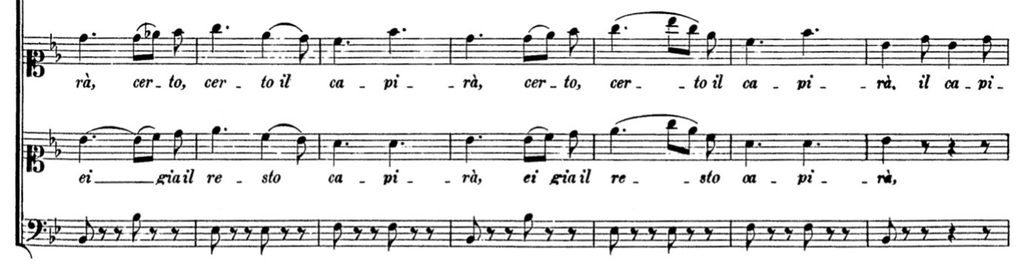
Example 1 Act 3, scene 10, Duettino “Sull’aria . . . che soave zeffiretto,” mm. 50–56. Wolfgang Amadeus Mozart, Le nozze di Figaro (Mozarts Werke; Breitkopf & Hártel, 1786/1879).
In the passage above from the final measures of “Sull’aria” (example 1), the two women—with Susanna singing the upper line and the Countess singing the lower—are united, singing in parallel with each other. This is a significant moment in the opera, as two female characters, separated by social class, sing together for a shared cause. Brown-Montesano labels the “Letter Duet” a “revolutionary document,” arguing for the individuality of the servants and women.30 This duet is also the only duet in all of Mozart’s operatic works that presents two women favorably together, in agreement with one another rather than arguing or siding against each other.31 This piece, sung by an aristocratic woman and her servant, offers a compelling moment in which two characters, each representing and transcending different kinds of inferiority, are united.
Throughout the piece, the Countess and Susanna alternate musical lines, as if engaging in a conversation. Their musical separation into two distinct lines illustrates their class separation and their social relationship as a countess and a servant. However, in these final measures in example 1, Susanna and the Countess are singing variations on the same lyrics, assuring each other and themselves that the Count will understand their plot to reveal his infidelity. Moreover, it seems that the Countess and Susanna are on the same level, with Susanna musically reaching to meet the Countess’s musical qualities of the sentimental heroine. However, Mozart also gives Susanna the higher melodic line, and so when she and the Countess sing together, Susanna musically surpasses the Countess. Throughout the lyrics, their melodic lines stay close, typically remaining a third apart; however, the final syllable ends with the Countess singing a sixth below Susanna. Despite this musical setting, Brown-Montesano states that both characters remain close to the boundaries of their differing social classes, allowing them to connect throughout the opera without explicitly upsetting any eighteenth-century mores.32 The women never irreversibly step beyond the boundaries of their social position, notwithstanding Mozart’s use of musical means to imply a malleability in class.33 Wye J. Allanbrook argues that “Susanna and the Countess are the characters at the opera’s centre; they step out from behind the masks of comic convention and in doing so enable some of the other characters, touched by the humanity of the two women, to undergo a similar metamorphosis.”34 In the final measures of “Sull’aria,” Mozart’s music implies a social reversal in which Susanna and the Countess are united and Susanna takes on the higher melodic line.
Hunter notes that the formerly popular opera buffa trope, derived from La serva padrona, in which a servant girl manipulates and marries a man of superior social status, had become rare in the Viennese operas of the 1770s and 1780s.35 Rather, in Le nozze di Figaro, Susanna, who would typically fulfill the role of the servant girl, works with the Countess—an aristocratic figure—to manipulate and expose the Count for his infidelity and pursuit of Susanna. In act 4, when Susanna and the Countess attempt to realize their plot to expose the Count, they swap clothing and pretend to be each other. While neither of them physically moves beyond their social class, Susanna swaps into aristocratic clothing, and the Countess into Susanna’s serving garments. This suggests a malleability of class boundaries within opera buffa, indicating that the lines between classes are not as rigid as they may seem. While much of Beaumarchais’s overtly political and revolutionary commentary is removed in Le nozze di Figaro, Mozart and Da Ponte use other means, such as stage direction and musical setting, often disguised and softened with a satirical tone, to infuse social criticism and reversals into the opera.
Susanna’s aria “Deh vieni” is one example of servants musically rising to the level of their masters in Le nozze di Figaro, as Tim Carter has argued.36 In this piece, Mozart gives Susanna melodies that are similar to those of the Countess, reflecting the servant’s maturity and also her musical and social ascent over the course of the opera. Many scholars have noted that the long-held notes in Susanna’s aria reflect the Countess’s held notes in “Porgi amor,” and these, in turn, allow Susanna to temporarily take on the role of the sentimental heroine through her own intimate aria. In this aria, Susanna musically ascends to the level of the Countess, adopting a legato melodic line where (as a servant character) she would usually sing faster, more syllabic melodies. This aria also occurs near the end of the opera, as Susanna is wearing the Countess’s clothes, furthering Susanna’s temporary embodiment of the sentimental heroine and aristocratic figure.
Through these subtle details—Susanna’s changing musical style and her attire—Mozart and Da Ponte introduce interesting social tensions and reversals. Moreover, Susanna is not the only character who engages in this musical ascension. Figaro, Susanna, and Marcellina all gain musical markers of higher status over the course of the opera, seemingly to “impart a kind of political message” (as Carter has written): “The lower classes are rising to the (musical) level of their superiors.”37 Throughout the opera, then, Mozart employs various musical styles in order to indicate status changes and introduce a political connotation into the play. Ultimately, musical techniques such as these allowed Mozart to convey a subversive message regarding the malleability of social classes without upsetting authority or risking censorship.
Conclusion
Le nozze di Figaro has captivated audiences across generations due to its profoundly realistic and human characters and the complicated social tensions and reversals that permeate the plot, music, and libretto. Throughout the opera, Mozart’s music, Da Ponte’s libretto, and Beaumarchais’s original narrative work together to illustrate complex ideas about eighteenth-century society and humanity as a whole. Le nozze di Figaro paradoxically both reflects the ideals of its time and reverses them, serving as a work of art that illustrates eighteenth-century society and the changes arising within it. While Le nozze di Figaro is not as overtly political or critical as Beaumarchais’s French play Le Mariage de Figaro, the subtle nuances and details provided through the music, libretto, and stage directions allow for countless interpretations and continuing discussions surrounding opera to take place. Le nozze di Figaro introduces perspectives regarding the malleability of social classes, femininity, and humanity at large; however, Mozart and Da Ponte are careful never to cross a boundary. In fact, by the end of the play, the aristocratic couple is reunited and both servants—Figaro and Susanna—marry one another. In other words, social order is reinstated and solidified. Through such means, Le nozze di Figaro pleases both traditional and progressive audiences, offering compelling questions that can never be definitively answered. Through the social reversals and tensions prevalent throughout the opera, Le nozze di Figaro provides a compelling and incisive reflection on its time, representing opposing ideals and changing values, pushing at the boundaries of social class but never definitively or irreversibly crossing them.
- Tim Carter, W. A. Mozart: Le nozze di Figaro (Cambridge University Press, 1987), 2.↗
- Daniel Heartz, “Goldoni, Opera Buffa, and Mozart’s Advent in Vienna,” in Opera Buffa in Mozart’s Vienna, edited by Mary Hunter and James Webster (Cambridge University Press, 1997).↗
- Roger Mathew Grant, “Peculiar Attunements: Comic Opera and Enlightenment Mimesis,” Critical Inquiry 43, no. 2 (2017): 551.↗
- Mary Hunter, The Culture of Opera Buffa in Mozart’s Vienna: A Poetics of Entertainment (Princeton University Press, 1999), 71.↗
- Grant, “Peculiar Attunements,” 557.↗
- Piero Weiss, “Goldoni, Carlo [Fegejo, Polisseno],” Grove Music Online, 2001.↗
- Carter, W. A. Mozart, 13.↗
- Hunter, Culture of Opera Buffa, 71.↗
- Hunter.↗
- Quoted in Heartz, “Goldoni, Opera Buffa,” 43.↗
- See Stefano Castelvecchi, “Sentimental and Anti-Sentimental in Le nozze di Figaro,” Journal of the American Musicological Society 53, no. 1 (2000): 1–24.↗
- Hunter, Culture of Opera Buffa, 71.↗
- Elizabeth MacArthur, “Embodying the Public Sphere: Censorship and the Reading Subject in Beaumarchais’s Mariage de Figaro,” Representations no. 61 (1998): 57.↗
- Michael Patterson, “Marriage of Figaro, The (La Folle Journée, ou, Le Mariage de Figaro),” in The Oxford Dictionary of Plays (Oxford University Press, 2005).↗
- Quoted in MacArthur, “Embodying the Public Sphere,” 57.↗
- MacArthur, 57.↗
- Frits Noske, “Social Tensions in Le nozze di Figaro,” Music & Letters 50, no. 1 (1969): 46.↗
- Carter, W. A. Mozart, 26.↗
- MacArthur, “Embodying the Public Sphere,” 58.↗
- Noske, “Social Tensions,” 46.↗
- Noske, 47.↗
- Quoted in Carter, W. A. Mozart, 48.↗
- Kristi Brown-Montesano, Understanding the Women of Mozart’s Operas (University of California Press, 2007), 170.↗
- Brown-Montesano, 155.↗
- Hunter, Culture of Opera Buffa, 73.↗
- Carter, W. A. Mozart, 46.↗
- Hunter, Culture of Opera Buffa, 89.↗
- Quoted in Carter, W. A. Mozart, 6.↗
- Carter.↗
- Brown-Montesano, Women of Mozart’s Operas, 156.↗
- Brown-Montesano, 193.↗
- Brown-Montesano, 158.↗
- Brown-Montesano, 156.↗
- Wye J. Allanbrook, “Pro Marcellina: The Shape of ‘Figaro,’ Act IV,” Music & Letters 63, nos. 1–2 (1982): 69.↗
- Hunter, Culture of Opera Buffa, 83.↗
- Carter, W. A. Mozart, 66.↗
- Carter, 26–27.↗